Pearson+ LogoPearson+ Logo
Ch. 20 - Population Genetics and Evolution at the Population, Species, and Molecular Levels
Sanders - Genetic Analysis: An Integrated Approach 3rd Edition
Sanders3rd EditionGenetic Analysis: An Integrated ApproachISBN: 9780135564172Not the one you use?Change textbook
Chapter 20, Problem 9

George Udny Yule was wrong in suggesting that an autosomal dominant trait like brachydactyly will increase in frequency in populations. Explain why Yule was incorrect.

Verified step by step guidance
1
Understand the concept of autosomal dominant traits: These are traits where only one copy of the dominant allele is needed for the trait to be expressed.
Consider the Hardy-Weinberg principle: This principle states that allele and genotype frequencies in a population will remain constant from generation to generation in the absence of other evolutionary influences.
Identify the factors that can change allele frequencies: These include mutation, selection, gene flow, genetic drift, and non-random mating.
Recognize that Yule's assumption ignores these factors: Yule assumed that the frequency of a dominant trait would naturally increase, but this ignores the balance of evolutionary forces that can maintain or even decrease allele frequencies.
Conclude that dominance does not equate to increased frequency: The dominance of an allele does not inherently lead to an increase in its frequency without selective advantage or other evolutionary pressures.

Verified video answer for a similar problem:

This video solution was recommended by our tutors as helpful for the problem above.
Video duration:
2m
Was this helpful?

Key Concepts

Here are the essential concepts you must grasp in order to answer the question correctly.

Autosomal Dominant Inheritance

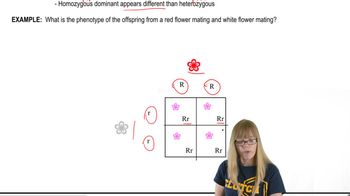
Autosomal dominant inheritance refers to a pattern where only one copy of a mutated gene from an affected parent can cause the trait to manifest in offspring. This means that individuals with the trait have a 50% chance of passing it on to their children. However, the trait's frequency in a population can be influenced by factors such as fitness and reproductive success.
Recommended video:
Guided course
04:37
Variations on Dominance

Population Genetics

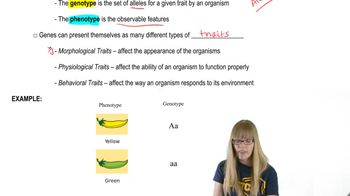
Population genetics studies the distribution and change in frequency of alleles within populations. Factors such as natural selection, genetic drift, and mutation can affect allele frequencies. In the case of brachydactyly, if the trait negatively impacts reproductive success, its frequency may not increase despite being autosomal dominant.
Recommended video:
Guided course
03:45
Descriptive Genetics

Fitness and Natural Selection

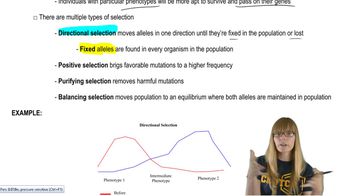
Fitness in genetics refers to an organism's ability to survive and reproduce in its environment. Natural selection can lead to a decrease in the frequency of traits that are disadvantageous for survival or reproduction. If brachydactyly reduces an individual's fitness, Yule's assumption that it would increase in frequency is flawed, as natural selection would likely counteract this increase.
Recommended video:
Guided course
05:54
Natural Selection
Related Practice
Textbook Question

Genetic drift, an evolutionary process affecting all populations, can have a significant effect in small populations, even though its effect is negligible in large populations. Explain why this is the case.

762
views
Textbook Question
Over the course of many generations in a small population, what effect does random genetic drift have on allele frequencies?
601
views
Textbook Question
Catastrophic events such as loss of habitat, famine, or overhunting can push species to the brink of extinction and result in a genetic bottleneck. What happens to allele frequencies in a species that experiences a near-extinction event, and what is expected to happen to allele frequencies if the species recovers from near extinction?
424
views
Textbook Question

The ability to taste the bitter compound phenylthiocarbamide (PTC) is an autosomal dominant trait. The inability to taste PTC is a recessive condition. In a sample of 500 people, 360 have the ability to taste PTC and 140 do not. Calculate the frequency of the recessive allele.

561
views
Textbook Question

The ability to taste the bitter compound phenylthiocarbamide (PTC) is an autosomal dominant trait. The inability to taste PTC is a recessive condition. In a sample of 500 people, 360 have the ability to taste PTC and 140 do not. Calculate the frequency of the dominant allele.

462
views
Textbook Question

The ability to taste the bitter compound phenylthiocarbamide (PTC) is an autosomal dominant trait. The inability to taste PTC is a recessive condition. In a sample of 500 people, 360 have the ability to taste PTC and 140 do not. Calculate the frequency of each genotype.

1235
views