Pearson+ LogoPearson+ Logo
Ch. 20 - Population Genetics and Evolution at the Population, Species, and Molecular Levels
Sanders - Genetic Analysis: An Integrated Approach 3rd Edition
Sanders3rd EditionGenetic Analysis: An Integrated ApproachISBN: 9780135564172Not the one you use?Change textbook
Chapter 20, Problem 7

Over the course of many generations in a small population, what effect does random genetic drift have on allele frequencies?

Verified step by step guidance
1
Understand that genetic drift is a mechanism of evolution that refers to random changes in the frequency of alleles in a population.
Recognize that in small populations, genetic drift has a more pronounced effect because random events can lead to significant changes in allele frequencies from one generation to the next.
Consider that over many generations, genetic drift can lead to the fixation or loss of alleles, meaning that an allele can become the only allele present in the population or be completely lost.
Acknowledge that genetic drift can reduce genetic variation within a population, as alleles are lost or fixed over time.
Note that genetic drift can lead to different populations diverging genetically from each other, especially if they are isolated, as random changes in allele frequencies accumulate over generations.

Verified video answer for a similar problem:

This video solution was recommended by our tutors as helpful for the problem above.
Video duration:
1m
Was this helpful?

Key Concepts

Here are the essential concepts you must grasp in order to answer the question correctly.

Random Genetic Drift

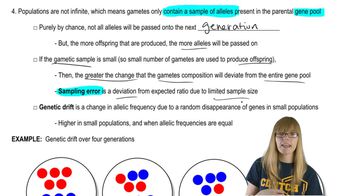
Random genetic drift is a mechanism of evolution that refers to random fluctuations in allele frequencies within a population due to chance events. In small populations, these random changes can lead to significant shifts in genetic variation over generations, potentially resulting in the loss of alleles or fixation of certain alleles, regardless of their adaptive value.
Recommended video:
Guided course
10:15
Genetic Drift

Allele Frequencies

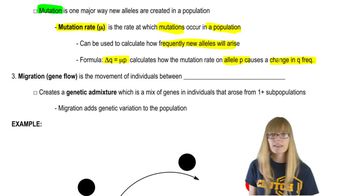
Allele frequencies represent the proportion of different alleles of a gene in a population. They are crucial for understanding genetic diversity and evolution, as changes in these frequencies can indicate how populations evolve over time. In the context of random genetic drift, allele frequencies can change unpredictably, leading to reduced genetic variation.
Recommended video:
Guided course
03:03
New Alleles and Migration

Population Size and Genetic Drift

The size of a population significantly influences the impact of random genetic drift. In smaller populations, the effects of drift are more pronounced, leading to greater fluctuations in allele frequencies. This can result in rapid evolutionary changes, whereas larger populations tend to buffer against such random changes, maintaining more stable allele frequencies over time.
Recommended video:
Guided course
10:15
Genetic Drift