Pearson+ LogoPearson+ Logo
Ch. 20 - Population Genetics and Evolution at the Population, Species, and Molecular Levels
Sanders - Genetic Analysis: An Integrated Approach 3rd Edition
Sanders3rd EditionGenetic Analysis: An Integrated ApproachISBN: 9780135564172Not the one you use?Change textbook
Chapter 20, Problem 5

Thinking creatively about evolutionary mechanisms, identify at least two schemes that could generate allelic polymorphism in a population. Do not include the processes described in the answer to Problem 4.

Verified step by step guidance
1
Step 1: Understand the concept of allelic polymorphism, which refers to the presence of two or more alleles at a locus within a population, contributing to genetic diversity.
Step 2: Recall that evolutionary mechanisms generating allelic polymorphism include mutation, natural selection, gene flow, genetic drift, and recombination, but exclude those mentioned in Problem 4 as per the instructions.
Step 3: Consider mutation as one scheme: random changes in DNA sequences introduce new alleles into the population, increasing allelic variation over time.
Step 4: Consider balancing selection as another scheme: this includes mechanisms like heterozygote advantage or frequency-dependent selection, which maintain multiple alleles in the population by favoring genetic diversity.
Step 5: Summarize that both mutation (introducing new alleles) and balancing selection (maintaining multiple alleles) are key evolutionary schemes that can generate and sustain allelic polymorphism in populations.

Verified video answer for a similar problem:

This video solution was recommended by our tutors as helpful for the problem above.
Video duration:
2m
Was this helpful?

Key Concepts

Here are the essential concepts you must grasp in order to answer the question correctly.

Allelic Polymorphism

Allelic polymorphism refers to the presence of two or more different alleles at a gene locus within a population. This genetic variation is essential for evolution and adaptation, as it provides the raw material for natural selection to act upon.
Recommended video:
Guided course
03:03
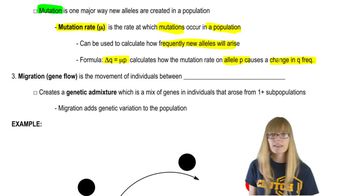
New Alleles and Migration

Balancing Selection

Balancing selection is an evolutionary mechanism that maintains multiple alleles in a population by providing a selective advantage to heterozygotes or through frequency-dependent selection. This process helps preserve genetic diversity and can generate stable allelic polymorphism.
Recommended video:
Guided course
05:54
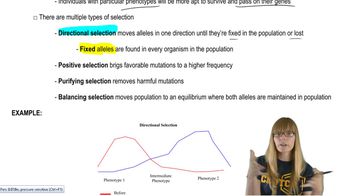
Natural Selection

Mutation and Gene Flow

Mutation introduces new alleles into a population by altering DNA sequences, while gene flow involves the transfer of alleles between populations through migration. Both mechanisms increase genetic variation and can contribute to the generation and maintenance of allelic polymorphism.
Recommended video:
Guided course
04:46
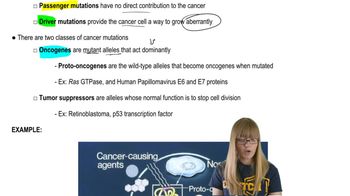
Cancer Mutations