Pearson+ LogoPearson+ Logo
Ch. 20 - Population Genetics and Evolution at the Population, Species, and Molecular Levels
Sanders - Genetic Analysis: An Integrated Approach 3rd Edition
Sanders3rd EditionGenetic Analysis: An Integrated ApproachISBN: 9780135564172Not the one you use?Change textbook
Chapter 20, Problem D.2

What insights have analyses of human mitochondrial DNA provided into our recent evolutionary past?

Verified step by step guidance
1
Understand that mitochondrial DNA (mtDNA) is inherited maternally and does not undergo recombination, making it a powerful tool for tracing maternal lineages over time.
Recognize that by comparing mtDNA sequences from diverse human populations, scientists can construct phylogenetic trees that reveal relationships and estimate the timing of common ancestors.
Learn that analyses of mtDNA have supported the 'Out of Africa' hypothesis, indicating that all modern humans share a recent common maternal ancestor who lived in Africa approximately 100,000 to 200,000 years ago.
Explore how mtDNA variation helps identify population bottlenecks, migrations, and expansions in human history, providing insights into how humans dispersed across the globe.
Note that mtDNA studies complement other genetic data and fossil evidence, together building a comprehensive picture of recent human evolutionary history.

Verified video answer for a similar problem:

This video solution was recommended by our tutors as helpful for the problem above.
Video duration:
2m
Was this helpful?

Key Concepts

Here are the essential concepts you must grasp in order to answer the question correctly.

Mitochondrial DNA (mtDNA) Characteristics

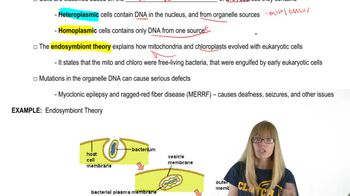
Mitochondrial DNA is a small, circular genome inherited maternally without recombination, making it a useful tool for tracing maternal lineages. Its high mutation rate allows for the detection of genetic differences over relatively short evolutionary timescales.
Recommended video:
Guided course
04:11
Organelle DNA Characteristics

Mitochondrial Eve and Human Evolution

Analyses of mtDNA have led to the concept of 'Mitochondrial Eve,' the most recent common maternal ancestor of all living humans, estimated to have lived in Africa about 150,000 to 200,000 years ago. This supports the 'Out of Africa' model of recent human evolution.
Recommended video:

Population Genetics and Human Migration

mtDNA variation patterns help reconstruct human migration routes and population expansions by revealing genetic diversity and lineage splits. These analyses provide insights into how modern humans dispersed globally and adapted to different environments.
Recommended video:
Guided course
03:03
New Alleles and Migration