The following figure illustrates reciprocal crosses involving chickens with sex-linked dominant barred mutation. For Cross A and for Cross B, cross the F₁ roosters and hens and predict the feather patterns of roosters and hens in the F2.

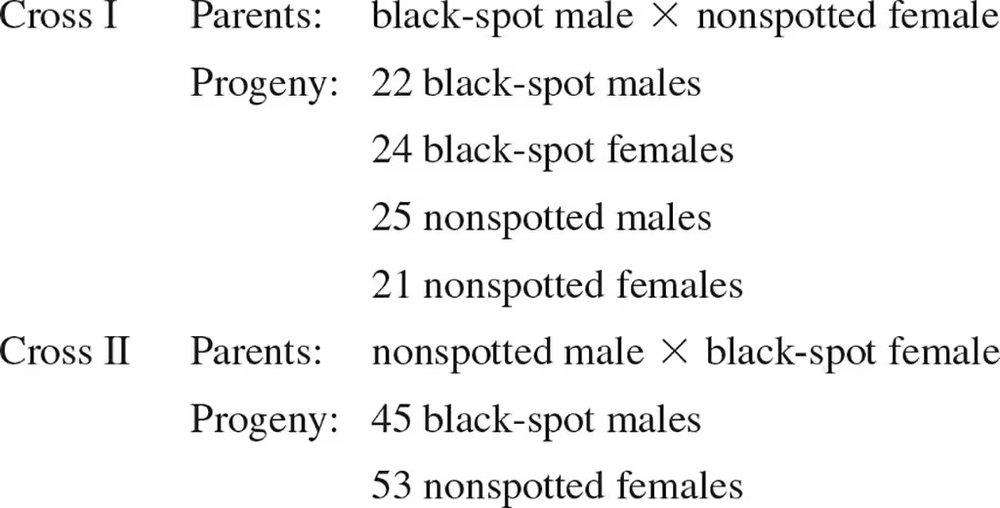
In a species of fish, a black spot on the dorsal fin is observed in males and females. A fish breeder carries out a pair of reciprocal crosses and observes the following results.

Identify which sex is heterogametic. Give genotypes for the parents in each cross, and explain the progeny proportions in each cross.
Verified step by step guidance
Verified video answer for a similar problem:
Key Concepts
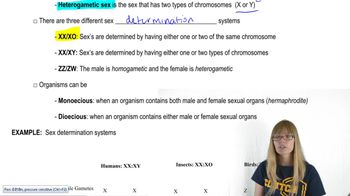
Sex Determination and Heterogamety
Genotype and Phenotype
Reciprocal Crosses
In fruit flies, yellow body (y) is recessive to gray body , and the trait of body color is inherited on the X chromosome. Vestigial wing (v) is recessive to full-sized wing (v⁺), and the trait has autosomal inheritance. A cross of a male with yellow body and full wings to a female with gray body and full wings is made. Based on an analysis of the progeny of the cross shown below, determine the genotypes of parental and progeny flies.
[Table below appears at this point containing crosses and results]
In a species of fish, a black spot on the dorsal fin is observed in males and females. A fish breeder carries out a pair of reciprocal crosses and observes the following results.
Why does this evidence support the hypothesis that a black spot is sex linked?
Lesch–Nyhan syndrome (OMIM 300322) is a rare X-linked recessive disorder that produces severe mental retardation, spastic cerebral palsy, and self-mutilation.
What is the probability that the first son of a woman whose brother has Lesch–Nyhan syndrome will be affected?
Lesch–Nyhan syndrome (OMIM 300322) is a rare X-linked recessive disorder that produces severe mental retardation, spastic cerebral palsy, and self-mutilation.
If the first son of the woman described in (a) is affected, what is the probability that her second son is affected?
Lesch–Nyhan syndrome (OMIM 300322) is a rare X-linked recessive disorder that produces severe mental retardation, spastic cerebral palsy, and self-mutilation.
What is the probability that the first son of a man whose brother has Lesch–Nyhan syndrome will be affected?
