Pearson+ LogoPearson+ Logo
Ch. 3 - Cell Division and Chromosome Heredity
Sanders - Genetic Analysis: An Integrated Approach 3rd Edition
Sanders3rd EditionGenetic Analysis: An Integrated ApproachISBN: 9780135564172Not the one you use?Change textbook
Chapter 3, Problem 25b

Lesch–Nyhan syndrome (OMIM 300322) is a rare X-linked recessive disorder that produces severe mental retardation, spastic cerebral palsy, and self-mutilation.


If the first son of the woman described in (a) is affected, what is the probability that her second son is affected?

Verified step by step guidance
1
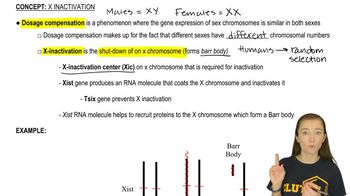
Understand that Lesch–Nyhan syndrome is an X-linked recessive disorder, meaning the gene responsible for the condition is located on the X chromosome, and males (XY) are more likely to be affected because they have only one X chromosome.
Recognize that for an X-linked recessive disorder, a female carrier (heterozygous) has a 50% chance of passing the affected X chromosome to her offspring. Sons who inherit the affected X chromosome will express the disorder because they do not have a second X chromosome to compensate.
Since the first son is affected, this confirms that the mother is a carrier of the disorder. However, the inheritance of the X chromosome by each child is independent of previous children.
For the second son, the probability of inheriting the affected X chromosome from the mother remains 50%, as each child’s inheritance is independent of their siblings.
Conclude that the probability of the second son being affected is 50%, based on the principles of independent assortment and the inheritance pattern of X-linked recessive disorders.

Verified video answer for a similar problem:

This video solution was recommended by our tutors as helpful for the problem above.
Video duration:
2m
Was this helpful?

Key Concepts

Here are the essential concepts you must grasp in order to answer the question correctly.

X-linked Recessive Inheritance

X-linked recessive inheritance refers to genetic conditions that are associated with genes located on the X chromosome. Males, having one X and one Y chromosome, are more likely to express these disorders if they inherit a single affected X chromosome. In contrast, females have two X chromosomes, so they would need to inherit two affected X chromosomes to express the disorder, making them typically carriers if they have one affected X.
Recommended video:
Guided course
09:30
X-Inactivation

Probability in Genetics

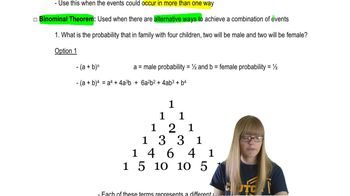
Probability in genetics involves calculating the likelihood of inheriting specific traits based on parental genotypes. In the case of X-linked disorders, the probability of a son being affected can be determined by considering the mother's genotype and whether she is a carrier or affected. This involves using Punnett squares or basic probability rules to assess the chances of offspring inheriting the affected allele.
Recommended video:

Punnett Square

A Punnett square is a diagram used to predict the genetic makeup of offspring from a particular cross. It helps visualize the possible combinations of alleles from the parents. For X-linked traits, the Punnett square can illustrate the inheritance patterns of the X chromosome from the mother to her sons, allowing for the calculation of probabilities regarding whether the second son will be affected by the disorder.
Recommended video:
Guided course
18:27
Chi Square Analysis
Related Practice
Textbook Question

In a species of fish, a black spot on the dorsal fin is observed in males and females. A fish breeder carries out a pair of reciprocal crosses and observes the following results.


Why does this evidence support the hypothesis that a black spot is sex linked?

471
views
Textbook Question

In a species of fish, a black spot on the dorsal fin is observed in males and females. A fish breeder carries out a pair of reciprocal crosses and observes the following results.

Identify which sex is heterogametic. Give genotypes for the parents in each cross, and explain the progeny proportions in each cross.

470
views
Textbook Question

Lesch–Nyhan syndrome (OMIM 300322) is a rare X-linked recessive disorder that produces severe mental retardation, spastic cerebral palsy, and self-mutilation.


What is the probability that the first son of a woman whose brother has Lesch–Nyhan syndrome will be affected?

675
views
Textbook Question

Lesch–Nyhan syndrome (OMIM 300322) is a rare X-linked recessive disorder that produces severe mental retardation, spastic cerebral palsy, and self-mutilation.


What is the probability that the first son of a man whose brother has Lesch–Nyhan syndrome will be affected?

665
views
Textbook Question

In humans, SRY is located near a pseudoautosomal region (PAR) of the Y chromosome, a region of homology between the X and Y chromosomes that allows them to synapse during meiosis in males and is a region of crossover between the chromosomes. The diagram below shows SRY in relation to the pseudoautosomal region.

About 1 in every 25,000 newborn infants is born with sex reversal; the infant is either an apparent male but with two X chromosomes or an apparent female but with an X and a Y chromosome. Explain the origin of sex reversal in human males and females involving the SRY gene. (Hint: See Experimental Insight 3.1 for a clue about the mutational mechanism.) 

886
views
Textbook Question

In an 1889 book titled Natural Inheritance (Macmillan, New York), Francis Galton, who investigated the inheritance of measurable (quantitative) traits, formulated a law of 'ancestral inheritance.' The law stated that individuals inherit approximately one-half of their genetic traits from each parent, about one-quarter of the traits from each grandparent, one-eighth from each great grandparent, and so on. In light of the chromosome theory of heredity, argue either in favor of Galton's law or against it.

519
views