Pearson+ LogoPearson+ Logo
Ch. 4 - Gene Interaction
Sanders - Genetic Analysis: An Integrated Approach 3rd Edition
Sanders3rd EditionGenetic Analysis: An Integrated ApproachISBN: 9780135564172Not the one you use?Change textbook
Chapter 4, Problem 37a

Epistatic gene interaction results in a modification of the F₂ dihybrid ratio.
What is the expected F₂ ratio?

Verified step by step guidance
1
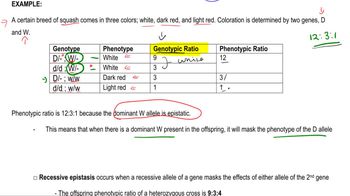
Understand the concept of epistasis: Epistasis occurs when one gene's expression masks or modifies the expression of another gene. This interaction can alter the expected Mendelian dihybrid ratio of 9:3:3:1 in the F₂ generation.
Identify the type of epistasis: Different types of epistasis (e.g., recessive, dominant, duplicate recessive, duplicate dominant) result in different modified ratios. For example, recessive epistasis typically results in a 9:3:4 ratio, while dominant epistasis results in a 12:3:1 ratio.
Determine the genotypes and phenotypes involved: Analyze the genetic cross to identify the alleles and their interactions. For example, if one gene (A/a) is epistatic to another gene (B/b), the phenotype associated with the epistatic gene will mask the phenotype of the other gene under certain conditions.
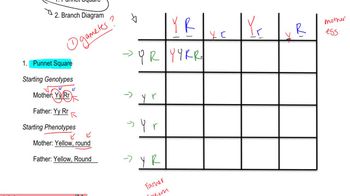
Set up a Punnett square: Use a dihybrid Punnett square to predict the genotypic combinations in the F₂ generation. Include all possible combinations of the two genes (e.g., AABB, AaBb, aabb, etc.).
Apply the epistatic interaction: Modify the phenotypic ratios based on the type of epistasis. For example, if recessive epistasis is present, combine the phenotypes of genotypes where the epistatic gene is homozygous recessive (e.g., aa__) into a single phenotypic category.

Verified video answer for a similar problem:

This video solution was recommended by our tutors as helpful for the problem above.
Video duration:
2m
Was this helpful?

Key Concepts

Here are the essential concepts you must grasp in order to answer the question correctly.

Epistasis

Epistasis refers to the interaction between genes where the expression of one gene (the epistatic gene) masks or modifies the expression of another gene (the hypostatic gene). This interaction can alter the expected phenotypic ratios in offspring, particularly in dihybrid crosses, leading to deviations from Mendelian ratios.
Recommended video:
Guided course
13:08
Epistatic Genes

Dihybrid Cross

A dihybrid cross involves two traits, each controlled by different genes, typically represented by two pairs of alleles. In a standard dihybrid cross of heterozygous parents (AaBb x AaBb), the expected phenotypic ratio in the F₂ generation is 9:3:3:1. However, epistatic interactions can change this ratio, necessitating a reevaluation of expected outcomes.
Recommended video:
Guided course
15:24
Punnet Square

F₂ Generation

The F₂ generation is the second filial generation, produced by crossing individuals from the F1 generation. In genetic studies, analyzing the F₂ generation helps determine the inheritance patterns and ratios of traits, which can be significantly affected by gene interactions such as epistasis, leading to modified phenotypic ratios compared to those predicted by Mendelian genetics.
Recommended video:
Guided course
08:52
F Factor and Hfr
Related Practice
Textbook Question

In a breed of domestic cattle, horns can appear on males and on females. Males and females can also be hornless. The following crosses are performed with parents from pure-breeding lines.

Explain the inheritance of this phenotype in cattle, and assign genotypes to all cattle in each cross.

481
views
Textbook Question

Cross-1 shown in the following figure illustrates genetic complementation of flower-color mutants. The produced from this cross of two pure-breeding mutant parental plants are dihybrid (CcPp) and have wild-type flower color. If these F₁ are allowed to self-fertilize, what phenotypes are expected in the F₂ , and what are the expected ratios of the phenotypes?


460
views
Textbook Question

The wild-type allele of a gene has an A–T base pair at a particular location in its sequence, and a mutant allele of the same gene has a G–C base pair at the same location. Otherwise, the sequences of the two alleles are identical. Does this information tell you anything about the dominance relationship of the alleles? Explain why or why not.

494
views
Textbook Question

Epistatic gene interaction results in a modification of the F₂ dihybrid ratio.

What genetic principle is the basis of this expected F₂ ratio?

462
views
Textbook Question

Epistatic gene interaction results in a modification of the F₂ dihybrid ratio.

Give two examples of modified F₂ ratios produced by epistatic gene interactions and describe how gene interaction results in the ratios.

577
views
Textbook Question

Draw a pedigree containing two parents and four children. Both of the parents have AB blood type. The first child is type A, the second child is type AB, and the third child is type B.


Assign the genotypes to these five people.

497
views