
Pearson+ LogoPearson+ Logo
Ch. 6 - Genetic Analysis and Mapping in Bacteria and Bacteriophages
Sanders - Genetic Analysis: An Integrated Approach 3rd Edition
Sanders3rd EditionGenetic Analysis: An Integrated ApproachISBN: 9780135564172Not the one you use?Change textbook
Chapter 6, Problem 9

How is the frequency of cotransduction related to the relative positions of genes on a bacterial chromosome? Draw a map of three genes and describe the expected relationship of cotransduction frequencies to the map.

Verified step by step guidance
1
Understand the concept of cotransduction: Cotransduction refers to the simultaneous transfer of two or more genes from a donor bacterium to a recipient bacterium via a bacteriophage. This process occurs when the genes are close enough on the bacterial chromosome to be packaged into the same phage particle during transduction.
Explain the relationship between cotransduction frequency and gene distance: The frequency of cotransduction is inversely proportional to the distance between genes on the bacterial chromosome. Genes that are closer together are more likely to be cotransduced because they are more likely to fit within the same fragment of DNA packaged by the bacteriophage.
Draw a hypothetical gene map: Consider three genes (A, B, and C) on a bacterial chromosome. Assume the relative positions are as follows: A and B are close together, while C is farther away from both A and B. The map could be represented as: A---B----------------C, where the dashes represent relative distances.
Describe the expected cotransduction frequencies: Based on the map, the cotransduction frequency between A and B will be higher because they are closer together. The cotransduction frequency between A and C, as well as between B and C, will be lower because C is farther away from both A and B.
Summarize the relationship: The closer two genes are on the bacterial chromosome, the higher their cotransduction frequency. This relationship can be used to infer the relative positions of genes and construct genetic maps based on experimental cotransduction data.

Verified video answer for a similar problem:

This video solution was recommended by our tutors as helpful for the problem above.
Video duration:
1m
Was this helpful?

Key Concepts

Here are the essential concepts you must grasp in order to answer the question correctly.

Cotransduction

Cotransduction is a genetic phenomenon where two or more genes are transferred together from one bacterium to another via a bacteriophage. The likelihood of cotransduction occurring is influenced by the physical proximity of the genes on the bacterial chromosome. Genes that are closer together are more likely to be packaged into the same viral particle, leading to higher cotransduction frequencies.
Recommended video:

Gene Mapping

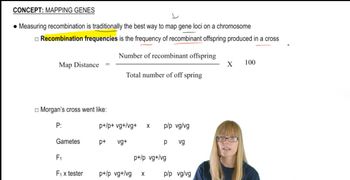
Gene mapping involves determining the relative positions of genes on a chromosome. In bacteria, this is often done using cotransduction frequencies as a measure of distance between genes. By analyzing how often two genes are cotransduced, researchers can infer their relative locations, with closer genes showing higher cotransduction rates.
Recommended video:
Guided course
09:09
Mapping Genes

Bacterial Chromosome Structure

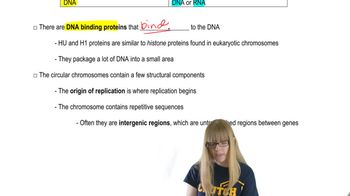
Bacterial chromosomes are typically circular and contain genes arranged in a linear order. The structure of the chromosome affects gene expression and the likelihood of genetic recombination events, such as cotransduction. Understanding the organization of genes on the chromosome is crucial for predicting the outcomes of genetic experiments and the relationships between gene positions.
Recommended video:
Guided course
02:39
Bacteria and Viral Chromosome Structure