Pearson+ LogoPearson+ Logo
Ch. 6 - Genetic Analysis and Mapping in Bacteria and Bacteriophages
Sanders - Genetic Analysis: An Integrated Approach 3rd Edition
Sanders3rd EditionGenetic Analysis: An Integrated ApproachISBN: 9780135564172Not the one you use?Change textbook
Chapter 6, Problem 8

What is a prophage, and how is a prophage formed?

Verified step by step guidance
1
A prophage is a form of a bacteriophage (a virus that infects bacteria) where the viral DNA is integrated into the bacterial host's genome. It remains dormant and does not cause immediate lysis of the host cell.
The formation of a prophage begins when a bacteriophage infects a bacterial cell and injects its DNA into the host.
Once inside the bacterial cell, the viral DNA can either enter the lytic cycle (leading to the destruction of the host cell) or the lysogenic cycle, where it integrates into the bacterial genome.
During the lysogenic cycle, the viral DNA integrates into the bacterial chromosome through a process called site-specific recombination. This integration is facilitated by enzymes encoded by the bacteriophage, such as integrase.
After integration, the viral DNA becomes a prophage and is replicated along with the bacterial genome during cell division. It remains dormant until certain conditions trigger its reactivation, leading to the lytic cycle.

Verified video answer for a similar problem:

This video solution was recommended by our tutors as helpful for the problem above.
Video duration:
2m
Was this helpful?

Key Concepts

Here are the essential concepts you must grasp in order to answer the question correctly.

Prophage Definition

A prophage is a form of a bacteriophage (a virus that infects bacteria) that has integrated its genetic material into the host bacterium's chromosome. This integration allows the viral DNA to be replicated along with the host's DNA during cell division, remaining dormant until certain conditions trigger its activation.
Recommended video:
Guided course
03:44
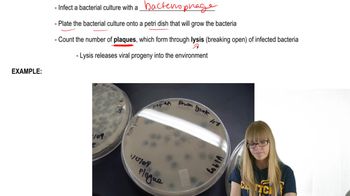
Plaques and Experiments

Lysogenic Cycle

The lysogenic cycle is one of the two main life cycles of bacteriophages, where the virus integrates its DNA into the host genome, forming a prophage. During this cycle, the prophage can remain inactive for long periods, allowing the host bacterium to reproduce normally while carrying the viral genetic material.
Recommended video:
Guided course
08:04
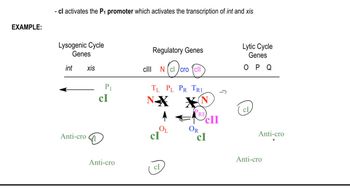
Decision Between Lytic and Lysogenic Cycles

Induction of Prophage

Induction is the process by which a prophage is activated to enter the lytic cycle, leading to the production of new viral particles. This can occur due to various environmental factors, such as stress or damage to the host cell, which trigger the prophage to excise itself from the host genome and begin replicating.
Recommended video:
Guided course
03:44
Plaques and Experiments