Describe what is meant by the term site-specific recombination as used in identifying the processes that lead to the integration of temperate bacteriophages into host bacterial chromosomes during lysogeny or to the formation of specialized transducing phage.
Sanders 3rd Edition
Ch. 6 - Genetic Analysis and Mapping in Bacteria and Bacteriophages
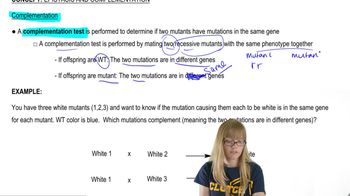
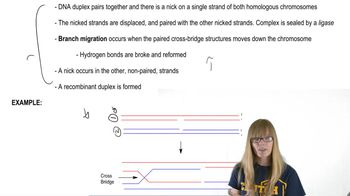
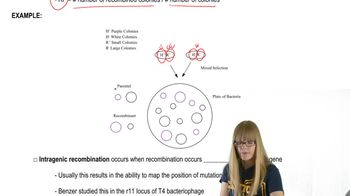
Problem 10Describe the differences between genetic complementation and recombination as they relate to the detection of wild-type lysis by a mutant bacteriophage.
Verified step by step guidance
Verified video answer for a similar problem:
Key Concepts
Genetic Complementation
Recombination
Bacteriophage Lysis
What is a prophage, and how is a prophage formed?
How is the frequency of cotransduction related to the relative positions of genes on a bacterial chromosome? Draw a map of three genes and describe the expected relationship of cotransduction frequencies to the map.
Among the mechanisms of gene transfer in bacteria, which one is capable of transferring the largest chromosome segment from donor to recipient? Which process generally transfers the smallest donor segments to the recipient? Explain your reasoning for both answers.
What is lateral gene transfer? How might it take place between two bacterial cells?
Lateral gene transfer is thought to have played a major role in the evolution of bacterial genomes. Describe the impact of LGT on bacterial genome evolution.