Pearson+ LogoPearson+ Logo
Ch. 8 - Molecular Biology of Transcription and RNA Processing
Sanders - Genetic Analysis: An Integrated Approach 3rd Edition
Sanders3rd EditionGenetic Analysis: An Integrated ApproachISBN: 9780135564172Not the one you use?Change textbook
Chapter 8, Problem 4a

The diagram below shows a DNA duplex. The template strand is identified, as is the location of the nucleotide.
Diagram of a DNA duplex showing the template and coding strands, with promoter and termination sequences indicated.
Assume this region contains a gene transcribed in a bacterium. Identify the location of promoter consensus sequences and of the transcription termination sequence.

Verified step by step guidance
1
Examine the DNA duplex diagram to identify the template strand and the direction of transcription (5' to 3' on the coding strand, 3' to 5' on the template strand).
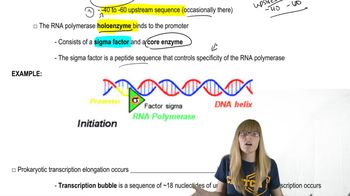
Locate the promoter region upstream of the gene. In bacteria, the promoter typically contains two consensus sequences: the -10 sequence (TATAAT) and the -35 sequence (TTGACA). These sequences are recognized by RNA polymerase and sigma factors.
Mark the -10 and -35 consensus sequences on the template strand, ensuring they are positioned correctly relative to the transcription start site (+1).
Identify the transcription termination sequence downstream of the gene. In bacteria, termination can occur via two mechanisms: Rho-dependent termination or intrinsic (Rho-independent) termination. For intrinsic termination, look for a GC-rich region followed by a series of uracils (poly-U) in the RNA transcript.
Label the termination sequence on the DNA duplex, ensuring it corresponds to the appropriate mechanism (e.g., intrinsic termination structure or Rho-binding site).

Verified video answer for a similar problem:

This video solution was recommended by our tutors as helpful for the problem above.
Video duration:
3m
Was this helpful?

Key Concepts

Here are the essential concepts you must grasp in order to answer the question correctly.

Promoter Consensus Sequences

Promoter consensus sequences are specific DNA sequences located upstream of a gene that signal the start of transcription. In bacteria, these sequences are recognized by RNA polymerase and associated transcription factors, facilitating the binding of the enzyme to initiate RNA synthesis. Common elements include the -10 (Pribnow box) and -35 regions, which are crucial for the proper recognition and binding of the transcription machinery.
Recommended video:
Guided course
08:55
Sequencing Overview

Transcription Termination Sequence

The transcription termination sequence is a specific region of DNA that signals the end of transcription. In bacteria, this sequence often contains a palindromic structure that forms a hairpin loop in the RNA transcript, followed by a series of uracil nucleotides. This structure destabilizes the RNA polymerase's interaction with the DNA, leading to the release of the newly synthesized RNA molecule.
Recommended video:
Guided course
10:14
Prokaryotic Transcription

DNA Duplex Structure

The DNA duplex structure refers to the double-helix formation of DNA, consisting of two complementary strands held together by base pairs. Each strand has a directionality, with a 5' end and a 3' end, which is crucial for processes like replication and transcription. Understanding this structure is essential for identifying the template strand and the orientation of genes within the DNA molecule.
Recommended video:
Guided course
06:25
DNA Structure