Pearson+ LogoPearson+ Logo
Ch. 9 - The Molecular Biology of Translation
Sanders - Genetic Analysis: An Integrated Approach 3rd Edition
Sanders3rd EditionGenetic Analysis: An Integrated ApproachISBN: 9780135564172Not the one you use?Change textbook
Chapter 9, Problem 39i

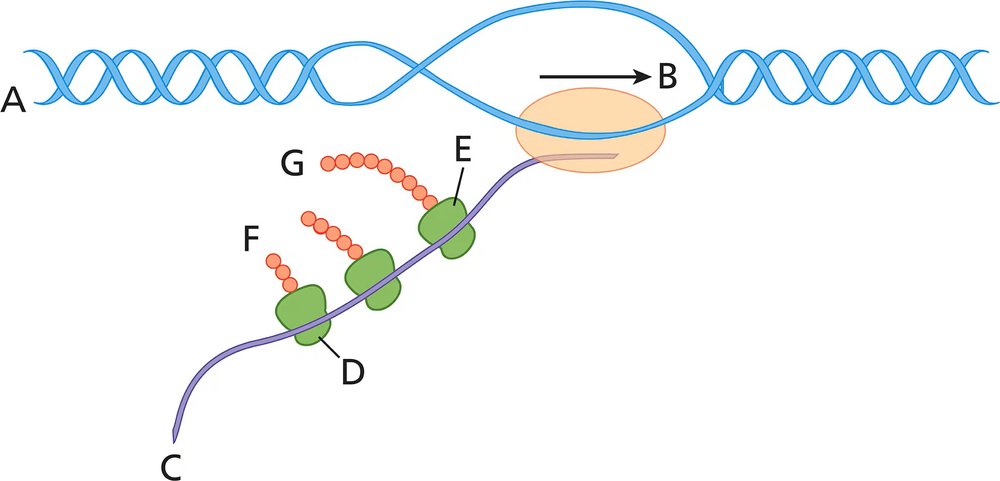
Answer the following questions about the accompanying diagram.
Diagram illustrating the process of translation, highlighting the position of fMet in relation to G.
Indicate where fMet is located in the string to the right of G. 

Verified step by step guidance
1
Examine the diagram provided. It illustrates the process of translation in genetics, where mRNA is being translated into a polypeptide chain. The ribosome is shown moving along the mRNA strand, and the labeled components include A (DNA), B (RNA polymerase), C (mRNA), D (ribosome), E (tRNA), F (polypeptide chain), and G (start codon).
Understand the role of fMet (formylmethionine). In prokaryotes, fMet is the first amino acid incorporated during translation. It is associated with the start codon (AUG) on the mRNA strand, which is recognized by the ribosome.
Locate the start codon (G) in the diagram. The start codon is the site where translation begins, and fMet is added to the growing polypeptide chain at this location.
Identify the position of fMet relative to G. Since fMet is the first amino acid, it is directly linked to the start codon (G) and is the initial amino acid in the polypeptide chain being synthesized.
Conclude that fMet is located at the beginning of the polypeptide chain, immediately to the right of G in the diagram, as translation proceeds in the 5' to 3' direction along the mRNA strand.

Verified video answer for a similar problem:

This video solution was recommended by our tutors as helpful for the problem above.
Video duration:
1m
Was this helpful?

Key Concepts

Here are the essential concepts you must grasp in order to answer the question correctly.

Translation in Genetics

Translation is the process by which ribosomes synthesize proteins using messenger RNA (mRNA) as a template. During translation, the ribosome reads the mRNA sequence in sets of three nucleotides, known as codons, each of which corresponds to a specific amino acid. This process is essential for gene expression and the production of proteins that perform various functions in the cell.
Recommended video:
Guided course
07:58
Translation initiation

Initiation Codon (fMet)

The initiation codon, typically AUG, codes for the amino acid methionine, which is often modified to form N-formylmethionine (fMet) in prokaryotes. fMet is crucial for the initiation of protein synthesis, as it is the first amino acid incorporated into the growing polypeptide chain. Its presence signals the start of translation, allowing the ribosome to assemble and begin synthesizing the protein.
Recommended video:
Guided course
07:58
Translation initiation

Ribosome Structure and Function

Ribosomes are complex molecular machines composed of ribosomal RNA (rRNA) and proteins, responsible for translating mRNA into polypeptides. They consist of two subunits (large and small) that come together during translation. The ribosome facilitates the binding of tRNA molecules, which carry specific amino acids, to the mRNA template, ensuring the correct sequence of amino acids in the resulting protein.
Recommended video:
Guided course
03:49
Ribosome Structure