Pearson+ LogoPearson+ Logo
Ch. 9 - The Molecular Biology of Translation
Sanders - Genetic Analysis: An Integrated Approach 3rd Edition
Sanders3rd EditionGenetic Analysis: An Integrated ApproachISBN: 9780135564172Not the one you use?Change textbook
Chapter 9, Problem 39j

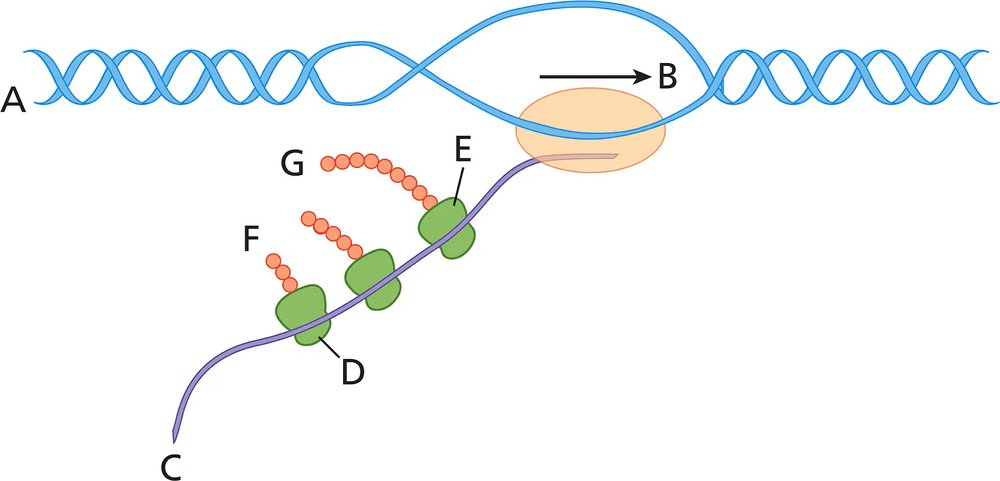
Answer the following questions about the accompanying diagram.
Diagram illustrating polypeptide synthesis with labeled components A, B, C, D, E, F, and G.
Which end of the polypeptide is closest to G? 

Verified step by step guidance
1
Examine the diagram provided. It illustrates the process of translation in genetics, where a polypeptide chain is synthesized based on the mRNA sequence. The labeled components include DNA (A), mRNA (C), ribosomes (D, E, F), and the growing polypeptide chain (G).
Understand the directionality of translation. Translation proceeds from the 5' end of the mRNA to the 3' end, and the polypeptide is synthesized from the N-terminus (amino end) to the C-terminus (carboxyl end).
Identify the labeled components in the diagram. The mRNA strand (C) is being translated by ribosomes (D, E, F), and the polypeptide chain (G) is shown growing from the ribosomes.
Determine the orientation of the polypeptide chain. The end of the polypeptide closest to the ribosome where translation is actively occurring (E) is the N-terminus, as new amino acids are added to the C-terminus during synthesis.
Conclude that the end of the polypeptide closest to G is the N-terminus, as G represents the growing polypeptide chain being synthesized from the ribosome.

Verified video answer for a similar problem:

This video solution was recommended by our tutors as helpful for the problem above.
Video duration:
1m
Was this helpful?

Key Concepts

Here are the essential concepts you must grasp in order to answer the question correctly.

Polypeptide Structure

A polypeptide is a chain of amino acids linked by peptide bonds, forming the building blocks of proteins. The sequence and arrangement of these amino acids determine the polypeptide's structure and function. In the context of translation, the polypeptide is synthesized from the amino (N) terminus to the carboxyl (C) terminus, which is crucial for understanding the orientation of the polypeptide in the diagram.
Recommended video:
Guided course
03:49
Ribosome Structure

Translation Process

Translation is the process by which ribosomes synthesize proteins using messenger RNA (mRNA) as a template. During translation, the ribosome reads the mRNA sequence in codons, each corresponding to a specific amino acid. The polypeptide chain grows as amino acids are added sequentially, starting from the N-terminus and extending towards the C-terminus, which is essential for interpreting the diagram's directionality.
Recommended video:
Guided course
08:39
mRNA Processing

Directionality of Polypeptides

Polypeptides have inherent directionality, with one end designated as the N-terminus (amino end) and the other as the C-terminus (carboxyl end). This directionality is critical for protein synthesis and function, as it influences how the polypeptide folds and interacts with other molecules. In the provided diagram, identifying which end is closest to point G requires understanding this directional aspect.
Recommended video:
Guided course
05:02
Directionality