Pearson+ LogoPearson+ Logo
Ch. 9 - The Molecular Biology of Translation
Sanders - Genetic Analysis: An Integrated Approach 3rd Edition
Sanders3rd EditionGenetic Analysis: An Integrated ApproachISBN: 9780135564172Not the one you use?Change textbook
Chapter 9, Problem 39h

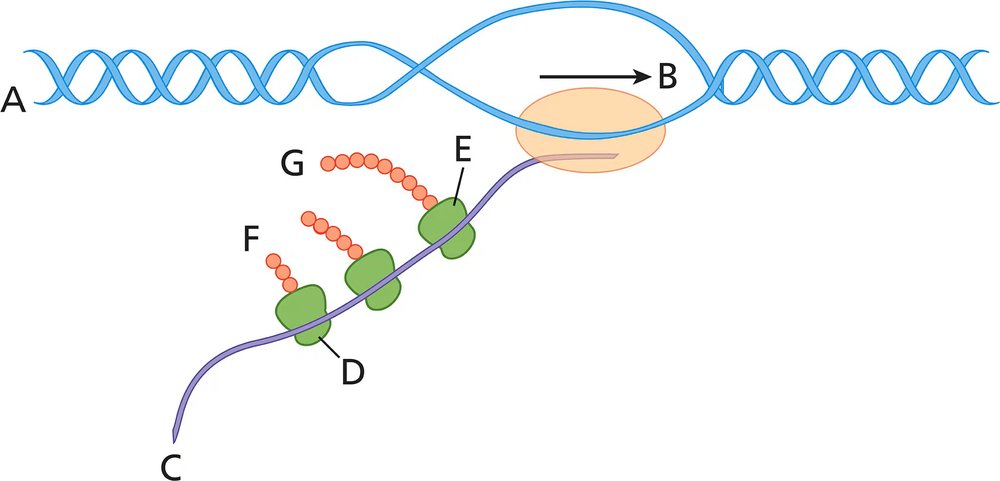
Answer the following questions about the accompanying diagram.
Diagram illustrating molecular translation, highlighting a string of beads labeled F.
What name is given to the object looking like a string of beads that is closest to F? 

Verified step by step guidance
1
Examine the diagram provided. The image illustrates the process of translation in genetics, where a strand of mRNA (labeled C) is being translated into a polypeptide chain.
Identify the labeled components in the diagram. The string of beads near F represents a growing polypeptide chain, which is being synthesized during translation.
Understand the role of the ribosome (labeled D and E). The ribosome facilitates the translation process by reading the mRNA sequence and assembling amino acids into a polypeptide chain.
Recognize that the string of beads closest to F is the polypeptide chain being synthesized. Each bead represents an amino acid, which is added sequentially to the chain as the ribosome moves along the mRNA.
Conclude that the object resembling a string of beads near F is called a polypeptide chain, which is the product of translation and will eventually fold into a functional protein.

Verified video answer for a similar problem:

This video solution was recommended by our tutors as helpful for the problem above.
Video duration:
1m
Was this helpful?

Key Concepts

Here are the essential concepts you must grasp in order to answer the question correctly.

Translation

Translation is the process by which ribosomes synthesize proteins using messenger RNA (mRNA) as a template. During translation, the ribosome reads the sequence of codons in the mRNA and assembles the corresponding amino acids into a polypeptide chain. This process is essential for gene expression and the production of proteins that perform various functions in the cell.
Recommended video:
Guided course
07:58
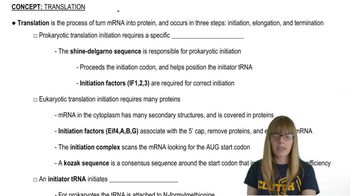
Translation initiation

Ribosome

The ribosome is a complex molecular machine found within all living cells that facilitates the translation of mRNA into proteins. It consists of ribosomal RNA (rRNA) and proteins, forming two subunits that come together during protein synthesis. The ribosome moves along the mRNA strand, decoding the genetic information and catalyzing the formation of peptide bonds between amino acids.
Recommended video:
Guided course
03:49
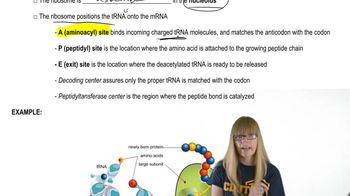
Ribosome Structure

Amino Acids

Amino acids are organic compounds that serve as the building blocks of proteins. There are 20 different amino acids that combine in various sequences to form proteins, each with unique properties that determine the protein's structure and function. In the context of translation, amino acids are brought to the ribosome by transfer RNA (tRNA) molecules, which match their anticodons to the codons on the mRNA.
Recommended video: