Pearson+ LogoPearson+ Logo
Ch. 9 - The Molecular Biology of Translation
Sanders - Genetic Analysis: An Integrated Approach 3rd Edition
Sanders3rd EditionGenetic Analysis: An Integrated ApproachISBN: 9780135564172Not the one you use?Change textbook
Chapter 9, Problem 39f

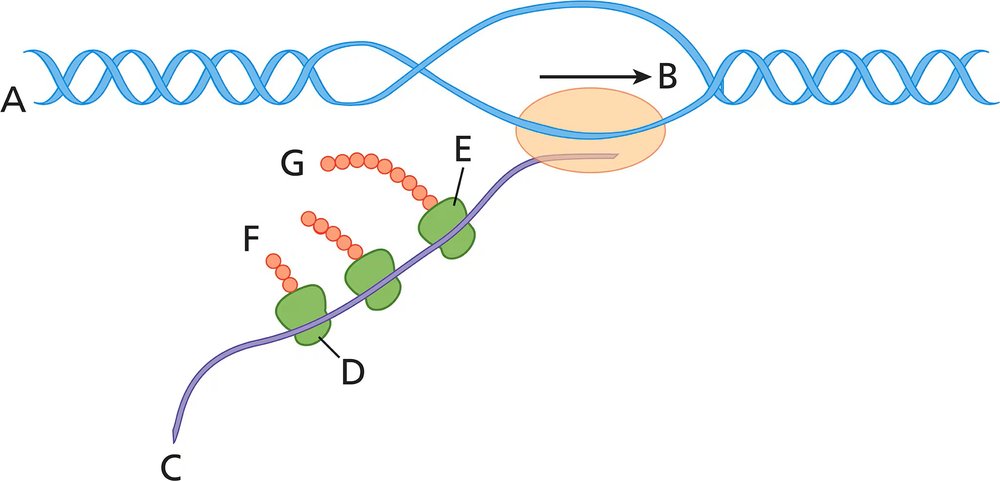
Answer the following questions about the accompanying diagram.
Diagram illustrating DNA transcription with labeled structures A, B, C, D, E, F, and G.
What structure is closest to D? Be specific. 

Verified step by step guidance
1
Examine the diagram provided. The labeled structures include A (double-stranded DNA), B (RNA polymerase), C (mRNA strand), D (ribosome), E (tRNA), F (polypeptide chain), and G (amino acids).
Identify the location of structure D in the diagram. Structure D is labeled as the ribosome, which is actively translating the mRNA strand (C).
Determine the structure closest to D. The ribosome (D) is directly interacting with structure E, which is labeled as tRNA. tRNA molecules are responsible for bringing amino acids to the ribosome during translation.
Understand the relationship between D and E. The ribosome (D) uses tRNA (E) to decode the mRNA sequence and assemble the polypeptide chain (F).
Conclude that the structure closest to D is E (tRNA), as it is directly involved in the translation process occurring at the ribosome.

Verified video answer for a similar problem:

This video solution was recommended by our tutors as helpful for the problem above.
Video duration:
2m
Was this helpful?

Key Concepts

Here are the essential concepts you must grasp in order to answer the question correctly.

Transcription

Transcription is the process by which the genetic information encoded in DNA is copied into messenger RNA (mRNA). This process involves the enzyme RNA polymerase, which binds to the DNA at a specific region and synthesizes a complementary RNA strand. Understanding transcription is crucial for interpreting the diagram, as it illustrates the steps and components involved in this fundamental biological process.
Recommended video:
Guided course
09:16
Eukaryotic Transcription

RNA Polymerase

RNA polymerase is the enzyme responsible for synthesizing RNA from a DNA template during transcription. It unwinds the DNA double helix and adds RNA nucleotides in a sequence complementary to the DNA strand. In the diagram, the structure labeled 'B' likely represents RNA polymerase, which is essential for initiating and elongating the RNA strand, making it a key player in the transcription process.
Recommended video:

Promoter Region

The promoter region is a specific sequence of DNA located upstream of a gene that signals the start of transcription. It is where RNA polymerase binds to initiate the transcription process. In the diagram, the structure labeled 'E' may represent elements of the promoter region, which are critical for the regulation of gene expression and determining where transcription begins.
Recommended video:
Guided course
00:30
Regions of X Chromosomes