Pearson+ LogoPearson+ Logo
Ch.14 Carboxylic Acids, Esters, Amines, and Amides
Timberlake - Chemistry: An Introduction to General, Organic, and Biological Chemistry 13th Edition
Timberlake13th EditionChemistry: An Introduction to General, Organic, and Biological ChemistryISBN: 9780134421353Not the one you use?Change textbook
Chapter 14, Problem 29c

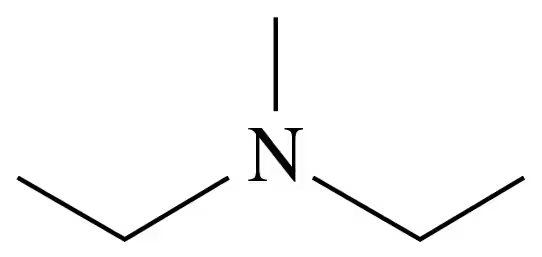
Write the common name for each of the following:
c. Chemical structure of a nitrogen atom bonded to two carbon chains, representing an amine compound.

Verified step by step guidance
1
Identify the structure of the compound in the image. Look for functional groups, the number of carbon atoms, and any branching or substituents present.
Determine the parent chain, which is the longest continuous chain of carbon atoms in the structure. This will help in identifying the base name of the compound.
Examine the substituents attached to the parent chain. Note their positions and types (e.g., methyl, ethyl, etc.).
Combine the substituents and the parent chain name to form the common name. Common names often use prefixes like 'iso-', 'sec-', or 'tert-' to describe branching.
Verify the common name by comparing it to standard naming conventions for similar compounds, ensuring accuracy and consistency.

Verified video answer for a similar problem:

This video solution was recommended by our tutors as helpful for the problem above.
Video duration:
3m
Was this helpful?

Key Concepts

Here are the essential concepts you must grasp in order to answer the question correctly.

Common Names in Biology

Common names are the everyday names used to refer to species, as opposed to their scientific names. They are often more accessible and easier to remember for the general public. However, common names can vary by region and language, leading to confusion. Understanding the context in which a common name is used is essential for accurate communication in biological discussions.

Taxonomy

Taxonomy is the science of classification of living organisms, which includes naming, describing, and categorizing species. It provides a systematic framework for identifying organisms and understanding their relationships. The scientific name of an organism, known as its binomial nomenclature, is derived from its genus and species, which helps avoid ambiguity associated with common names.

Image Identification

Image identification involves recognizing and naming organisms based on visual characteristics presented in an image. This process requires knowledge of distinguishing features such as color, shape, size, and habitat. Effective image identification is crucial in fields like biology and ecology, where visual cues can aid in the accurate classification and understanding of biodiversity.
Recommended video:
Guided course
04:50
Chromatography