Pearson+ LogoPearson+ Logo
Ch.6 Ionic and Molecular Compounds
Timberlake - Chemistry: An Introduction to General, Organic, and Biological Chemistry 13th Edition
Timberlake13th EditionChemistry: An Introduction to General, Organic, and Biological ChemistryISBN: 9780134421353Not the one you use?Change textbook
Chapter 6, Problem 153a

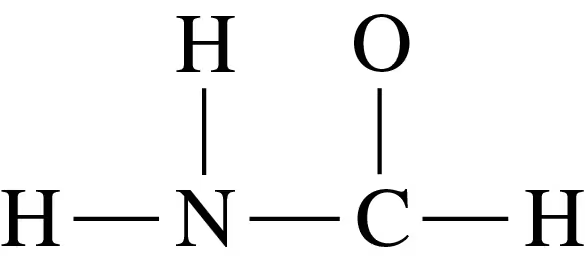
Complete the Lewis structure for each of the following:
a. Lewis dot structure showing hydrogen, nitrogen, carbon, and oxygen atoms with bonds represented by lines.

Verified step by step guidance
1
Step 1: Identify the central atoms in the structure. In this case, the central atoms are carbon (C) and nitrogen (N). Carbon typically forms four bonds, and nitrogen typically forms three bonds.
Step 2: Count the valence electrons for each atom. Carbon has 4 valence electrons, nitrogen has 5 valence electrons, oxygen has 6 valence electrons, and hydrogen has 1 valence electron.
Step 3: Ensure that each atom satisfies the octet rule (or duet rule for hydrogen). Carbon atoms should have four bonds, nitrogen should have three bonds and a lone pair, oxygen should have two bonds and two lone pairs, and hydrogen should have one bond.
Step 4: Add lone pairs to oxygen and nitrogen where necessary. Oxygen should have two lone pairs to complete its octet, and nitrogen should have one lone pair to complete its octet.
Step 5: Verify the structure by checking that the total number of valence electrons used matches the sum of valence electrons for all atoms in the molecule. Adjust if necessary to ensure all atoms are correctly bonded and satisfy their respective rules.

Verified video answer for a similar problem:

This video solution was recommended by our tutors as helpful for the problem above.
Video duration:
10m
Was this helpful?

Key Concepts

Here are the essential concepts you must grasp in order to answer the question correctly.

Lewis Structure

A Lewis structure is a diagram that represents the bonding between atoms in a molecule and the lone pairs of electrons that may exist. It uses dots to represent electrons and lines to represent bonds between atoms. Understanding how to draw Lewis structures is essential for visualizing molecular geometry and predicting the behavior of molecules in chemical reactions.
Recommended video:
Guided course
03:11
Lewis Dot Structures: Ions (Simplified) Concept 1

Valence Electrons

Valence electrons are the outermost electrons of an atom and are crucial in determining how an atom bonds with others. The number of valence electrons influences the atom's ability to form bonds, either by sharing, losing, or gaining electrons. Knowing how to count and utilize valence electrons is fundamental when constructing Lewis structures.
Recommended video:
Guided course
01:55
Valence Electrons of Elements (Simplified) Concept 1

Multiple Bonds

Multiple bonds refer to the sharing of more than one pair of electrons between two atoms, typically seen as double or triple bonds. These bonds occur when atoms require additional electrons to achieve a stable electron configuration, often seen in molecules with carbon, nitrogen, and oxygen. Recognizing the presence of multiple bonds is vital for accurately completing Lewis structures.
Recommended video:
Guided course
02:26
Multiple Bonds Concept 1