Pearson+ LogoPearson+ Logo
Ch.13 Carbohydrates
Timberlake - Chemistry: An Introduction to General, Organic, and Biological Chemistry 13th Edition
Timberlake13th EditionChemistry: An Introduction to General, Organic, and Biological ChemistryISBN: 9780134421353Not the one you use?Change textbook
Chapter 13, Problem 60a

 What are the disaccharides and polysaccharides present in each of the following?
a. <IMAGE>

Verified step by step guidance
1
Identify the disaccharides and polysaccharides by analyzing the structure of the carbohydrate in the provided image. Look for glycosidic bonds, which are the linkages between monosaccharide units.
Recall that disaccharides are composed of two monosaccharide units joined by a glycosidic bond. Common examples include sucrose, lactose, and maltose. Match the structure in the image to one of these disaccharides.
Polysaccharides are long chains of monosaccharide units linked by glycosidic bonds. Examples include starch, glycogen, and cellulose. Determine if the structure in the image represents a polysaccharide by identifying repeating units and the type of glycosidic linkage (e.g., α-1,4 or β-1,4).
For each structure in the image, classify it as either a disaccharide or a polysaccharide based on the number of monosaccharide units and the type of glycosidic bond present.
Summarize the findings by naming the specific disaccharides and polysaccharides identified in the image, ensuring to note their structural features and biological significance.

Verified video answer for a similar problem:

This video solution was recommended by our tutors as helpful for the problem above.
Video duration:
47s
Was this helpful?

Key Concepts

Here are the essential concepts you must grasp in order to answer the question correctly.

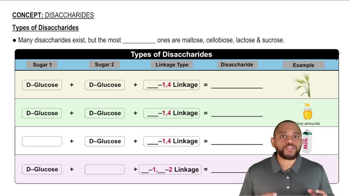
Disaccharides

Disaccharides are carbohydrates formed by the combination of two monosaccharide molecules through a glycosidic bond. Common examples include sucrose (glucose + fructose) and lactose (glucose + galactose). They serve as important energy sources and are found in various foods, playing a crucial role in nutrition.
Recommended video:
Guided course
3:39
Types of Disaccharides Concept 1

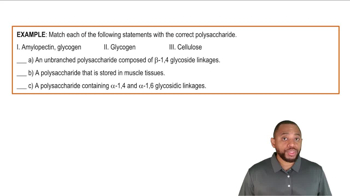
Polysaccharides

Polysaccharides are complex carbohydrates composed of long chains of monosaccharide units linked together. They can be classified into storage polysaccharides, like starch and glycogen, and structural polysaccharides, such as cellulose. These molecules are vital for energy storage and providing structural support in plants and animals.
Recommended video:
Guided course
1:24
Polysaccharides Example 1

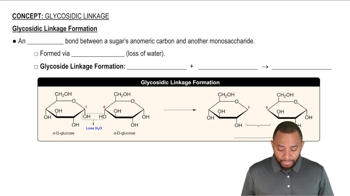
Glycosidic Bonds

Glycosidic bonds are covalent linkages formed between the hydroxyl group of one sugar molecule and the anomeric carbon of another, resulting in the formation of disaccharides and polysaccharides. The type of glycosidic bond (alpha or beta) influences the properties and digestibility of the carbohydrate, impacting its biological function.
Recommended video:
Guided course
1:44
Glycosidic Linkage Formation Concept 1