Pearson+ LogoPearson+ Logo
Ch.4 Atoms and Elements
Timberlake - Chemistry: An Introduction to General, Organic, and Biological Chemistry 13th Edition
Timberlake13th EditionChemistry: An Introduction to General, Organic, and Biological ChemistryISBN: 9780134421353Not the one you use?Change textbook
Chapter 4, Problem 37b

Argon has three naturally occurring isotopes, with mass numbers 36, 38, and 40.
b. How are these isotopes alike?

Verified step by step guidance
1
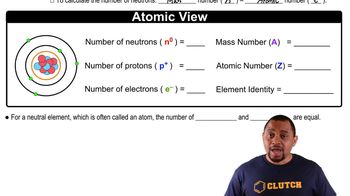
Understand the concept of isotopes: Isotopes are atoms of the same element that have the same number of protons but different numbers of neutrons. This means they share the same atomic number but differ in their mass numbers.
Identify the element in question: Argon is the element being discussed. Its atomic number is 18, which means all isotopes of argon have 18 protons.
Recognize the similarity among isotopes: Since isotopes of argon all have the same number of protons (18), they also have the same chemical properties because chemical behavior is determined by the electron configuration, which depends on the number of protons.
Note the shared characteristics: All isotopes of argon are chemically identical, belong to the same element, and occupy the same position in the periodic table.
Conclude the similarity: The isotopes of argon are alike because they have the same number of protons (18), the same atomic number, and the same electron configuration, which results in identical chemical properties.

Verified video answer for a similar problem:

This video solution was recommended by our tutors as helpful for the problem above.
Video duration:
1m
Was this helpful?

Key Concepts

Here are the essential concepts you must grasp in order to answer the question correctly.

Isotopes

Isotopes are variants of a chemical element that have the same number of protons but different numbers of neutrons. This results in different mass numbers for each isotope. For example, argon has isotopes with mass numbers 36, 38, and 40, all of which are forms of argon but differ in their neutron count.
Recommended video:

Chemical Properties

Isotopes of an element exhibit nearly identical chemical properties because they have the same electron configuration. This means that isotopes of argon will react similarly in chemical reactions, despite their differences in mass. Their behavior in chemical processes is largely determined by their electron arrangement rather than their mass.
Recommended video:
Guided course
02:11
Chemical Properties Example 1

Stability and Radioactivity

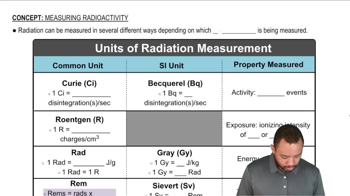
Isotopes can be stable or unstable (radioactive). Stable isotopes do not undergo radioactive decay, while unstable isotopes do, leading to the emission of radiation. In the case of argon, the isotopes 36 and 38 are stable, while 40Ar is also stable, which means they do not change into other elements over time.
Recommended video:
Guided course
02:52
Measuring Radioactivity Concept 1