Pearson+ LogoPearson+ Logo
Ch.6 Ionic and Molecular Compounds
Timberlake - Chemistry: An Introduction to General, Organic, and Biological Chemistry 13th Edition
Timberlake13th EditionChemistry: An Introduction to General, Organic, and Biological ChemistryISBN: 9780134421353Not the one you use?Change textbook
Chapter 6, Problem 93b

What noble gas has the same electron arrangement as the magnesium ion?

Verified step by step guidance
1
Determine the electron configuration of a neutral magnesium (Mg) atom. Magnesium has an atomic number of 12, meaning it has 12 electrons. Its electron configuration is: 1s22s22p63s2.
Understand that a magnesium ion (Mg2+) is formed when magnesium loses two electrons. These two electrons are removed from the outermost shell, which is the 3s orbital.
Write the electron configuration for the Mg2+ ion after losing two electrons: 1s22s22p6. This configuration corresponds to a total of 10 electrons.
Identify the noble gas that has the same electron configuration as Mg2+. Noble gases are elements in Group 18 of the periodic table, and their electron configurations are fully filled shells. The noble gas with 10 electrons is neon (Ne).
Conclude that the magnesium ion (Mg2+) has the same electron arrangement as the noble gas neon (Ne).

Verified video answer for a similar problem:

This video solution was recommended by our tutors as helpful for the problem above.
Video duration:
1m
Was this helpful?

Key Concepts

Here are the essential concepts you must grasp in order to answer the question correctly.

Electron Configuration

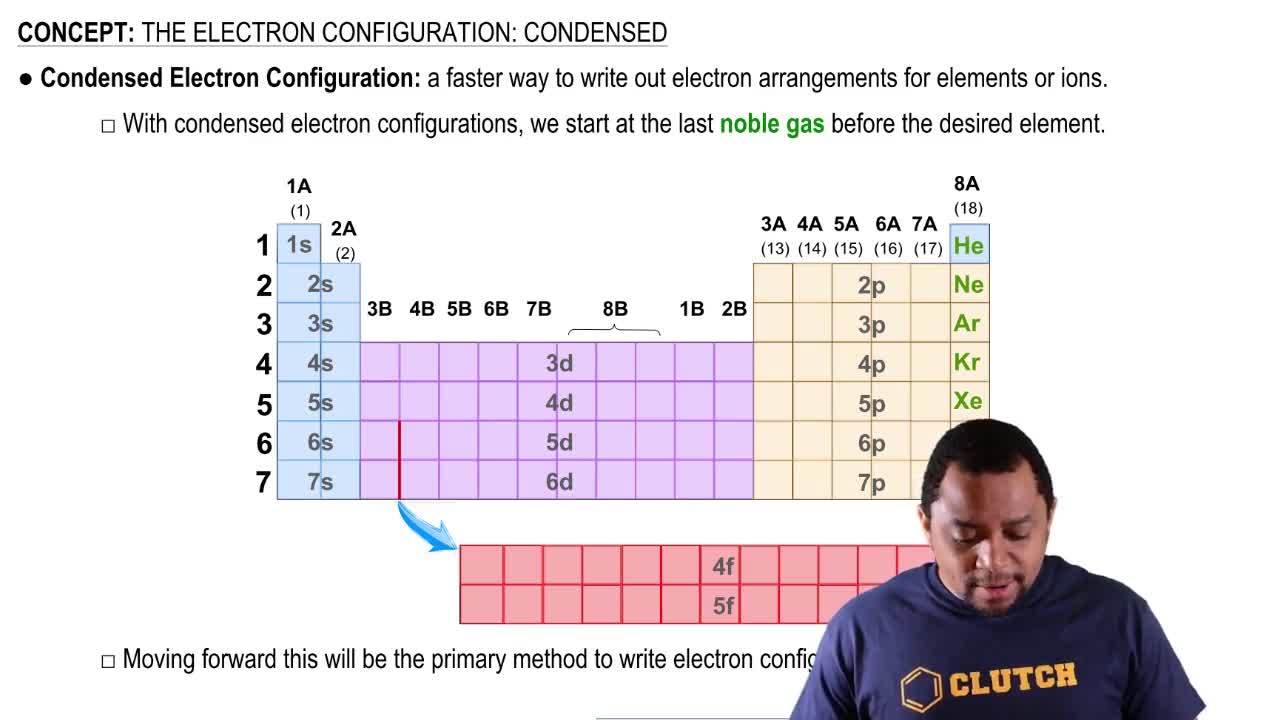
Electron configuration refers to the distribution of electrons in an atom's orbitals. For magnesium, which has an atomic number of 12, the electron configuration is 1s² 2s² 2p⁶ 3s². When it loses two electrons to form a magnesium ion (Mg²⁺), its configuration changes to 1s² 2s² 2p⁶, resembling that of a noble gas.
Recommended video:
Guided course
01:08
The Electron Configuration: Condensed

Noble Gases

Noble gases are a group of elements in Group 18 of the periodic table, known for their full valence electron shells, which make them chemically inert. The noble gases include helium, neon, argon, krypton, xenon, and radon. The noble gas that shares the same electron configuration as the magnesium ion is neon, which has an atomic number of 10 and an electron configuration of 1s² 2s² 2p⁶.
Recommended video:
Guided course
14:42
Test for Anions

Ion Formation

Ion formation occurs when an atom gains or loses electrons, resulting in a charged particle. A magnesium atom can lose two electrons to form a Mg²⁺ ion, which has a positive charge. This process is crucial for understanding how elements interact and achieve stable electron configurations similar to those of noble gases.
Recommended video:
Guided course
1:41
Amide Formation Concept 1