Pearson+ LogoPearson+ Logo
Ch.6 Ionic and Molecular Compounds
Timberlake - Chemistry: An Introduction to General, Organic, and Biological Chemistry 13th Edition
Timberlake13th EditionChemistry: An Introduction to General, Organic, and Biological ChemistryISBN: 9780134421353Not the one you use?Change textbook
Chapter 6, Problem 24e

Write the name for each of the following ions (include the Roman numeral when necessary):
e. Au3+

Verified step by step guidance
1
Determine the element represented by the symbol 'Au'. The symbol 'Au' corresponds to gold, which is a transition metal.
Identify the charge on the ion. The superscript '³⁺' indicates that the ion has a +3 charge.
Recall that transition metals often require a Roman numeral in their name to indicate the charge of the ion. This is because transition metals can form ions with different charges.
Combine the name of the element (gold) with the Roman numeral representing the charge (III) in parentheses. The Roman numeral III corresponds to a +3 charge.
The name of the ion is 'gold(III) ion'.

Verified video answer for a similar problem:

This video solution was recommended by our tutors as helpful for the problem above.
Video duration:
51s
Was this helpful?

Key Concepts

Here are the essential concepts you must grasp in order to answer the question correctly.

Ionic Charge

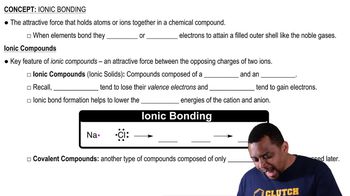
Ionic charge refers to the electrical charge that an ion carries, which is determined by the loss or gain of electrons. In the case of Au³⁺, the '³⁺' indicates that the gold ion has lost three electrons, resulting in a positive charge. Understanding ionic charges is essential for naming ions correctly, as it informs the oxidation state of the element.
Recommended video:
Guided course
02:33
Ionic Bonding Concept 1

Roman Numerals in Nomenclature

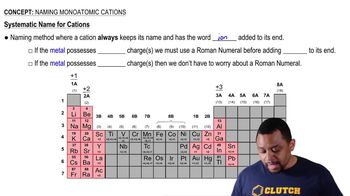
Roman numerals are used in chemical nomenclature to indicate the oxidation state of transition metals in compounds. For example, in the name 'gold(III)', the Roman numeral 'III' signifies that gold has a +3 oxidation state. This practice is crucial for distinguishing between different ionic forms of the same element, especially for metals that can exhibit multiple oxidation states.
Recommended video:
Guided course
01:24
Naming Monoatomic Cations Concept 1

Naming Cations

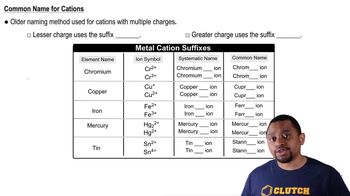
Naming cations involves identifying the element and its charge. For transition metals like gold, the name of the element is followed by the oxidation state in Roman numerals. In the case of Au³⁺, the correct name is 'gold(III)', which reflects both the identity of the ion and its positive charge, ensuring clarity in chemical communication.
Recommended video:
Guided course
03:28
Naming Monoatomic Cations Concept 2