Pearson+ LogoPearson+ Logo
Ch.6 Ionic and Molecular Compounds
Timberlake - Chemistry: An Introduction to General, Organic, and Biological Chemistry 13th Edition
Timberlake13th EditionChemistry: An Introduction to General, Organic, and Biological ChemistryISBN: 9780134421353Not the one you use?Change textbook
Chapter 6, Problem 11a

Write the names for each of the following ions:
a. Li+

Verified step by step guidance
1
Step 1: Recognize that the given ion is 'Li⁺', which represents a lithium ion with a positive charge.
Step 2: Recall that the name of a monatomic cation (a single atom with a positive charge) is the same as the name of the element, followed by the word 'ion'.
Step 3: Identify the element 'Li' as lithium from the periodic table.
Step 4: Combine the element name 'lithium' with the word 'ion' to form the name 'lithium ion'.
Step 5: Confirm that no Roman numeral is needed in the name because lithium is in Group 1 of the periodic table and always forms a +1 charge.

Verified video answer for a similar problem:

This video solution was recommended by our tutors as helpful for the problem above.
Video duration:
31s
Was this helpful?

Key Concepts

Here are the essential concepts you must grasp in order to answer the question correctly.

Ionic Charge

Ionic charge refers to the electrical charge that an ion carries, which results from the loss or gain of electrons. In the case of Li⁺, lithium has lost one electron, giving it a positive charge of +1. Understanding ionic charge is essential for identifying the nature of ions and their behavior in chemical reactions.
Recommended video:
Guided course
02:33
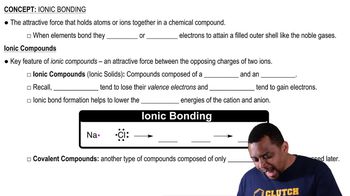
Ionic Bonding Concept 1

Cation

A cation is a positively charged ion that is formed when an atom loses one or more electrons. Since Li⁺ is derived from lithium, which has lost an electron, it is classified as a cation. Recognizing the difference between cations and anions (negatively charged ions) is crucial for understanding ionic compounds and their properties.
Recommended video:
Guided course
03:28
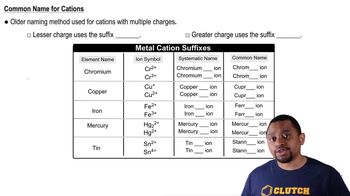
Naming Monoatomic Cations Concept 2

Nomenclature of Ions

Nomenclature of ions involves the systematic naming of ions based on their elemental composition and charge. For example, Li⁺ is named lithium ion, where the name reflects the element (lithium) and its ionic state (positive charge). Familiarity with ion nomenclature is important for accurately communicating chemical information and understanding formulas in chemistry.
Recommended video:
Guided course
01:16
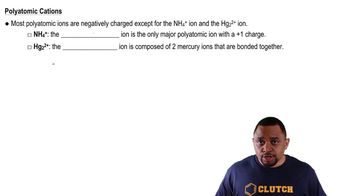
Polyatomic Ions