Adding Whole Numbers: Videos & Practice Problems
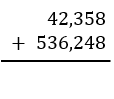
Adding Whole Numbers focuses on finding a sum by lining numbers up by place value and adding from right to left. Digits are matched in the ones, tens, hundreds, and larger places so each column represents the same value. When a column total is greater than 9, write the digit for the current place and carry the extra value to the next column.
This topic also uses the commutative property and associative property of addition to make adding easier. The commutative property shows that changing the order of addends does not change the sum, and the associative property shows that changing the grouping does not change the sum. The addition property of 0 is also important: \(a+0=a\) . These ideas help simplify expressions and support accurate addition of whole numbers, including larger numbers with multiple place values.
Solving Addition Problems


Find the following sums.
Find the following sums.
Find the following sums.
Solving Addition Problems Example 1
Carrying (ReGrouping) To Solve Addition Problems
Carrying (ReGrouping) To Solve Addition Problems Example 2
Add.

Add.

4908
Add.
Properties of Addition
Properties of Addition Example 3
Rewrite the expression using the stated property, then find the sum.
| commutative property
Rewrite the expression using the stated property, then find the sum.
| associative property
Rewrite the expression using the stated property, then find the sum.
| associative property
Rewrite the expression using the stated property, then find the sum.
| addition property of 0
Use the properties of addition to find the sum of the expression.
Here's what students ask on this topic:
To add whole numbers using place value, first line up the numbers vertically so that the digits are aligned by their place values (ones under ones, tens under tens, etc.). Start adding from the rightmost column (ones place) and move left. If the sum of a column is greater than 9, write down the digit in the current place and carry over the extra value to the next column on the left. Continue this process for all columns until all digits are added. This method ensures that each digit is added according to its value, making the addition accurate and organized.
The commutative property of addition states that changing the order of addends does not change the sum. In MathML, this is expressed as . This property helps simplify addition because you can rearrange numbers to make the calculation easier. For example, if you have , you can also think of it as , which might be easier to add mentally. This flexibility is especially useful when adding multiple whole numbers.
The associative property of addition means that the way numbers are grouped when adding does not affect the sum. In MathML, it is shown as . This property allows you to group numbers in a way that makes addition easier. For example, when adding , you can first add to get , then add to get . This flexibility helps in mental math and reduces errors.
The addition property of zero states that adding zero to any whole number does not change the number. In MathML, this is written as . This property is important because it confirms that zero is the additive identity, meaning it leaves numbers unchanged when added. Understanding this helps students recognize that zero can be used in addition without affecting the sum, which is useful in simplifying expressions and solving equations.
When adding whole numbers with multiple place values, if the sum of digits in a column exceeds 9, you write down the digit in the ones place of that sum and carry over the digit in the tens place to the next column on the left. For example, if adding the ones column results in 15, write down and carry over to the tens column. Then add this carried over to the digits in the tens column. This process ensures that each place value is correctly accounted for in the final sum.