Ch. 2 - Biochemistry Basics
Norman-McKay- Microbiology: Basic and Clinical Principles 2nd Edition
Norman-McKay2nd EditionMicrobiology: Basic and Clinical PrinciplesISBN: 9780137661619Not the one you use?Change textbook
Chapter 2, Problem 2

What ions result when hydrogen donates one electron to fluorine?

Verified step by step guidance
1
Identify the elements involved: hydrogen (H) and fluorine (F). Hydrogen has one electron, and fluorine has seven electrons in its outer shell.
Understand the electron transfer: when hydrogen donates one electron, it loses an electron and becomes a positively charged ion (cation).
Determine the ion formed by hydrogen after losing an electron: it becomes a hydrogen ion, represented as \(\mathrm{H}^{+}\).
Determine the ion formed by fluorine after gaining one electron: it gains an electron to complete its outer shell, becoming a negatively charged ion (anion), represented as \(\mathrm{F}^{-}\).
Conclude that the ions resulting from this electron transfer are \(\mathrm{H}^{+}\) (hydrogen ion) and \(\mathrm{F}^{-}\) (fluoride ion).

Verified video answer for a similar problem:

This video solution was recommended by our tutors as helpful for the problem above.
Video duration:
3m
Was this helpful?

Key Concepts

Here are the essential concepts you must grasp in order to answer the question correctly.

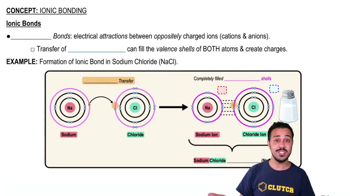
Ionic Bond Formation

Ionic bonds form when one atom donates electrons to another, resulting in oppositely charged ions that attract each other. In this process, the donor atom becomes a positively charged ion (cation), and the acceptor becomes a negatively charged ion (anion).
Recommended video:

Electron Transfer Between Hydrogen and Fluorine

When hydrogen donates one electron to fluorine, hydrogen loses an electron and becomes a hydrogen ion (H⁺), while fluorine gains an electron and becomes a fluoride ion (F⁻). This electron transfer leads to the formation of ions with opposite charges.
Recommended video:
Guided course
05:03
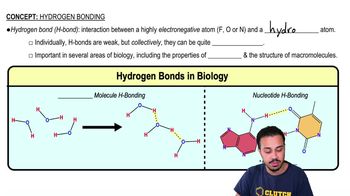
Hydrogen Bonding

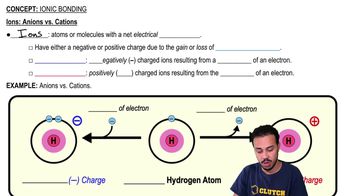
Charge and Ion Notation

Ions are represented with their chemical symbol followed by a superscript indicating their charge. For example, H⁺ indicates a hydrogen ion with a positive charge, and F⁻ indicates a fluoride ion with a negative charge, reflecting the gain or loss of electrons.
Recommended video:
Guided course
04:34
Ionic Bonding