Back
Back
Problem 1
Which type of hypersensitivity is not antibody mediated?
a. Type I hypersensitivities
b. Type II hypersensitivities
c. Type III hypersensitivities
d. Type IV hypersensitivities
e. Antibodies mediate all of these.
Problem 2
A patient has developed a type III reaction to a drug. Which of the following is the most immediate action required?
a. Lower the patient’s fever
b. Stop administration of the drug
c. Treat the patient’s skin rash to avoid possible infections
d. Hook the patient up to an IV for rehydration therapy
e. Administer antihistamines to limit the response
Problem 3
Indicate the true statements, and then reword the false statements so they are true.
a. Immunodeficiencies are associated with a decreased cancer risk
b. Type I reactions are mediated by IgG antibodies
c. Autoimmune disorders are not caused by type I hypersensitivities
d. Systemic lupus is mainly mediated by a type III hypersensitivity
e. A person with type 0- blood is called a universal donor
f. Immunotherapies are useful to reduce type II reactions
Problem 4
Which of the following would be recommended as a means to diagnose a type I sensitivity? Select all that apply.
a. Skin prick test
b. IgG titers
c. IgM titers
d. IgE titers
e. Histamine levels
Problem 5
Which of the following is the most suggestive of an anaphylactic reaction? (NCLEX/HESI/TEAS)
a. Sudden fever
b. A localized rash
c. Nasal congestion
d. Hemorrhage
e. Respiratory distress
Problem 6
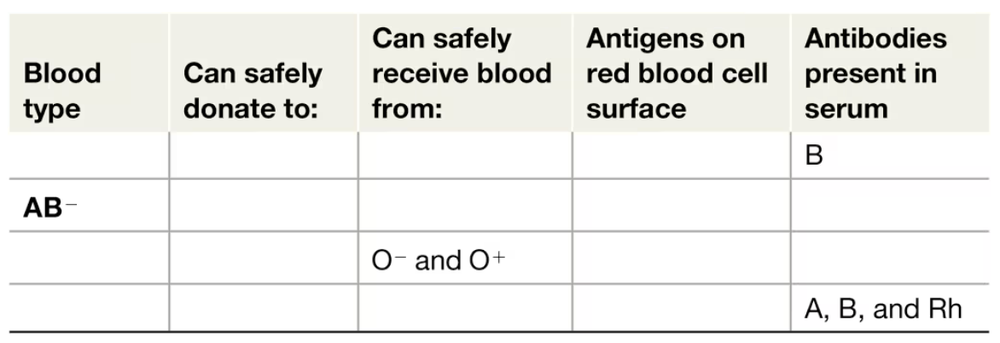
Fill in the table.
Problem 7
Which scenario presents the greatest risk for HDN developing?
a. O− mother with O+ fetus
b. A+ mother with O+ fetus
c. B−mother with AB− fetus
d. A−mother with O−fetus
e. AB+ mother with AB−fetus
Problem 8
Which patient would be the most likely to benefit from desensitization immunotherapy?
a. A person suffering from serum sickness
b. A person at risk for HDN during pregnancy
c. A person with an allergy to pollen
d. A transplant patient
e. An asthmatic patient
Problem 9
List the applicable hypersensitivities (type I, II, III, IV) as they relate to the description. Note, more than one type of hypersensitivity may be listed for a given description.
IgG antibodies can mediate type _________________hypersensitivities.
T cells mediate type _________________ hypersensitivities.
Type _________________ hypersensitivities may be generated in response to pharmaceutical drugs.
Type _________________ hypersensitivities may be associated with autoimmunity.
Type _________________ hypersensitivities require a sensitizing exposure.
IgE antibodies can mediate type _________________hypersensitivities.
Problem 10
Which of the following is (are) true regarding type III hypersensitivity reactions? Select all that apply.
a. They involve IgG
b. They involve IgM
c. They are considered delayed reactions
d. They include autoimmune disorders like multiple sclerosis
e. They are rare compared with type I reactions
Problem 11
Which of the following is the most likely to lead to graft-versushost disease?
a. An allogeneic bone marrow transplant
b. An allogeneic liver transplant
c. A xenogeneic heart valve transplant
d. An isogenic bone marrow transplant
e. A xenogeneic skin graft
Problem 12
Imagine that one of your patients is an emergency medical technician who has a family history of autoimmune disorders and allergy, but she does not currently suffer from either. Which of the following is (are) most likely true of your patient? Select all that apply.
a. She is at an increased risk for cancer
b. She is at an increased risk for type I hypersensitivities
c. She is at an increased risk for type III hypersensitivities
d. She is at an increased risk for latex hypersensitivity
e. She is at an increased risk for immunosuppression
Problem 13
Which types of white blood cells are most likely to be involved in type I hypersensitivities? Select all that apply.
a. T helper cells
b. T cytotoxic cells
c. Basophils
d. Macrophages
e. Mast cells
Problem 14
What is the general goal of treatments used for autoimmune disorders?
Problem 15
Which of the following is (are) true regarding primary immunodeficiencies? Select all that apply.
a. These disorders tend to be present from birth.
b. These disorders are also called congenital immunodeficiencies.
c. These disorders are more common in elderly patients.
d. Patients with these disorders may not have a familial history of immunodeficiencies.
e. Patients with these disorders tend to experience recurring, persistent, and severe infections, often caused by uncommon agents.