Problem 3.7a
Which of the following statements is true?
a. The cell walls of bacteria are composed of peptidoglycan.
b. Peptidoglycan is a fatty acid.
c. Gram-positive bacterial walls have a relatively thin layer of peptidoglycan anchored to the cytoplasmic membrane by teichoic acids.
d. Peptidoglycan is found mainly in the cell walls of fungi, algae, and plants.
Problem 3.7a
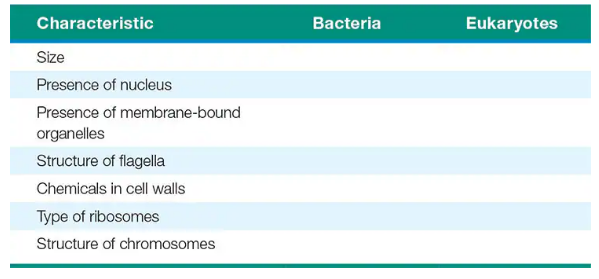
Compare bacterial cells and algal cells, giving at least four similarities and four differences.
Problem 3.8
Contrast a cell of Streptococcus pyogenes (a bacterium) with the unicellular protozoan Entamoeba histolytica, listing at least eight differences.
Problem 3.8a
Which of the following is not a function of a glycocalyx?
a. It forms pseudopods for faster mobility of an organism.
b. It can protect a bacterial cell from drying out.
c. It hides a bacterial cell from other cells.
d. It allows a bacterium to stick to a host.
Problem 3.8a
Which of the following is not a function of a glycocalyx?
a. It forms pseudopods for faster mobility of an organism.
b. It can protect a bacterial cell from drying out.
c. It hides a bacterial cell from other cells.
d. It allows a bacterium to stick to a host.
Problem 3.9a
Bacterial flagella are __________ .
a. anchored to the cell by a basal body
b. composed of hami
c. surrounded by an extension of the cytoplasmic membrane
d. composed of tubulin in hollow microtubules in a "9 + 2" arrangement
Problem 3.9a
Differentiate among pili, fimbriae, and cilia, using sketches and descriptive labels.
Problem 7.3a
A plasmid is __________ .
a. a molecule of RNA found in bacterial cells
b. distinguished from a chromosome by being circular
c. a structure in bacterial cells formed from plasma membrane
d. extrachromosomal DNA
Problem 10
Can nonliving things metabolize? Explain your answer.
Problem 11.1a
For each of the following statements that is true, write “true” in the blank. For each statement that is false, write the word(s) that should be substituted for the underlined word(s) to make the statement correct.
__________ All prokaryotes reproduce sexually.
Problem 11.1a
The type of reproduction in prokaryotes that results in a palisade arrangement of cells is called ___________ .
a. pleomorphic division
b. endospore formation
c. snapping division
d. binary fission
Problem 11.10a
The presence of mycolic acid in the cell wall characterizes __________ .
a. Corynebacterium
b. Listeria
c. Nocardia
d. Mycobacterium
Problem 11.1a
Label the shapes of these prokaryotic cells.
a. ___________ <IMAGE>
b. ___________ <IMAGE>
c. ___________ <IMAGE>
d. ___________ <IMAGE>
e. ___________ <IMAGE> stiff
f. ___________ <IMAGE> flexible
g. ___________ <IMAGE>
Problem 11.2a
For each of the following statements that is true, write “true” in the blank. For each statement that is false, write the word(s) that should be substituted for the underlined word(s) to make the statement correct.
__________ A bacillus is a bacterium with a slightly curved rod shape.
Problem 11.2a
Describe the location of these endospores within their cells.
Endospores Endospore
<IMAGE> <IMAGE>
(a) (b)
Problem 11.3
The thick-walled reproductive spores produced in the middle of cyanobacterial filaments are called .
a. Akinetes
b. Terminal endospores
c. Metachromatic granules
d. Heterocysts
Problem 11.3a
Name and describe three types of bacteria mentioned in this chapter that “glide.”
Problem 11.3a
For each of the following statements that is true, write “true” in the blank. For each statement that is false, write the word(s) that should be substituted for the underlined word(s) to make the statement correct.
__________ If you were to view staphylococci, you should expect to see clusters of cells.
Problem 11.3s
Which of the following terms best describes stiff, spiral-shaped prokaryotic cells?
a. Cocci
b. Bacilli
c. Spirilla
d. Spirochetes
Problem 11.4a
For each of the following statements that is true, write “true” in the blank. For each statement that is false, write the word(s) that should be substituted for the underlined word(s) to make the statement correct.
__________ Chlamydias have peptidoglycan cell walls.
Problem 11.4a
Endospores ___________ .
a. remain alive for decades
b. can remain alive in boiling water
c. exist in a state of suspended animation
d. All of the above are correct.
Problem 11.4a
Name three groups of low G + C Gram-positive bacteria.
Problem 11.6a
A student was memorizing the arrangements of bacteria and noticed that there are more arrangements for cocci than for bacilli. Why might this be so?
Problem 11.8a
Flexible spiral-shaped prokaryotes are __________ .
a. spirilla
b. spirochetes
c. vibrios
d. rickettsias
Problem 11.9
For each of the following statements that is true, write “true” in the blank. For each statement that is false, write the word(s) that should be substituted for the underlined word(s) to make the statement correct.
__________ A giant bacterium that is large enough to be seen without a microscope is Selenomonas.
Problem 11.9a
Describe the special features of snapping division that distinguish it from regular binary fission.
Problem 12.10a
Chrysolaminarin is a storage product found in which group of microbes?
a. dinoflagellates
b. euglenids
c. golden algae
d. brown algae
Problem 12.1a
Match the terms below with their corresponding definitions.
1. _________Mitosis
2. _________Meiosis
3. _________Homologous chromosomes
4. _________Crossing over
5. _________Cytokinesis
A. Cytoplasmic division
B. Diploid nuclei producing haploid nuclei
C. Results in genetic variation
D. Carry similar genes
E. Diploid nuclei producing diploid nuclei
Problem 12.1a
Compare and contrast the following closely related terms:
a. Chromatid and chromosome
b. Mitosis and meiosis II
c. Hypha and mycelium
Problem 12.11a
Which of the following features characterizes diatoms?
a. laminarin and oils as food reserves
b. protective plates of cellulose within their cells
c. chlorophylls a and c and carotene
d. paramylon as a food storage molecule
Ch. 3 - Cell Structure and Function