Here are the essential concepts you must grasp in order to answer the question correctly.
Endosymbiotic Theory
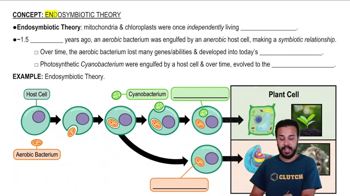
The endosymbiotic theory proposes that certain organelles in eukaryotic cells, such as mitochondria and chloroplasts, originated from free-living prokaryotes that were engulfed by ancestral host cells. This symbiotic relationship became permanent, leading to the evolution of complex eukaryotic cells.
Recommended video:
Evidence Supporting Endosymbiotic Theory
Evidence includes the presence of double membranes around mitochondria and chloroplasts, their own circular DNA similar to bacteria, and their ability to replicate independently within the cell. Additionally, these organelles have ribosomes resembling those of prokaryotes, supporting their bacterial origin.
Recommended video:
Limitations of the Endosymbiotic Theory
While the theory explains the origin of mitochondria and chloroplasts, it does not account for other eukaryotic features like the nucleus, endoplasmic reticulum, or cytoskeleton. These structures likely evolved through different mechanisms, indicating the theory covers only part of eukaryotic cell evolution.
Recommended video: