Back
Back
Problem 1
Which of the following include eukaryotic cells? Select all that apply.
a. Fungi
b. Yeasts
c. Protista
d. Bacteria
e. Helminths
f. Animalia
g. Archaea
h. Plantae
Problem 2
Which of the following are not characteristics of eukaryotes? Select all that apply.
a. They are generally simpler than prokaryotes.
b. They can be multicellular.
c. They all have a nucleus.
d. They tend to have multiple chromosomes.
e. They can have a cell wall.
f. They include pathogens.
g. They divide by mitosis.
h. They make up the Domain Archaea.
i. They make up the Domain Bacteria.
j. They make up the Domain Eukarya.
Problem 3
Indicate the true statements about eukaryotic cells and then reword the false statements so that they are true.
a. Eukaryotic cells have 70S ribosomes on the rough endoplasmic reticulum.
b. Eukaryotic cells sexually reproduce by mitosis.
c. Eukaryotic cells can make up unicellular or multicellular organisms.
d. Eukaryotic cells always have a cell wall.
e. Eukaryotic cells can be photosynthetic.
f. Eukaryotic cells use fimbriae for motility.
g. Yeast is a multicellular eukaryote.
Problem 4
Which of the following are characteristics of the Kingdom Fungi? Select all that apply.
a. They have a cell wall.
b. They are mainly unicellular.
c. They are mostly pathogens.
d. They contain peptidoglycan in their cell wall.
e. Some are photosynthetic.
f. They lack mitochondria.
g. They are prokaryotic and eukaryotic.
Problem 5
In what group of protozoans would you place the following organism? <IMAGE>
Problem 6
___________________ is an exportation process used in eukaryotes and involves vesicles that may bud off the Golgi apparatus. In contrast, ___________________ is an importation process by which a solid or a dissolved substance enters the cell by being engulfed by invaginations of the plasma membrane.
Problem 7
___________________ is also called cell drinking and is an example of an endocytic process.
Problem 8
The presence of which of the following would be helpful in distinguishing a prokaryote from a eukaryote? Select all that apply.
a. Peptidoglycan
b. Phospholipids
c. A cell wall
d. A nucleus
e. Chloroplasts
f. Ribosomes
g. Ability to carry out active transport
h. DNA
Problem 9
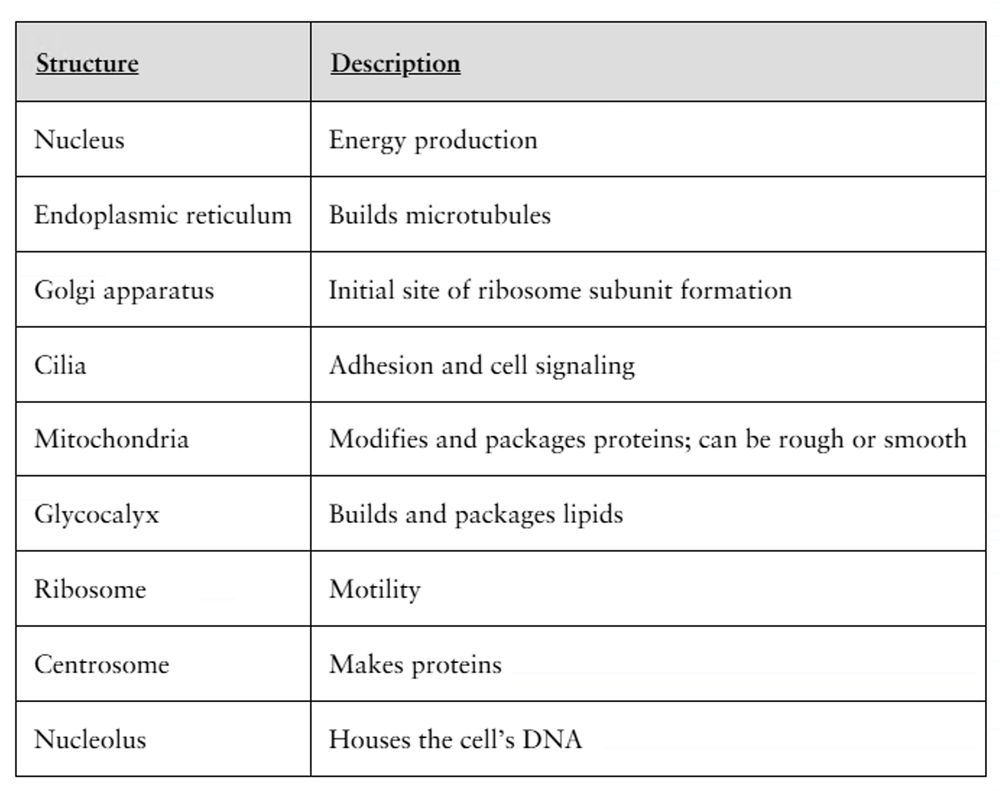
Match the organelle to the function
Problem 10
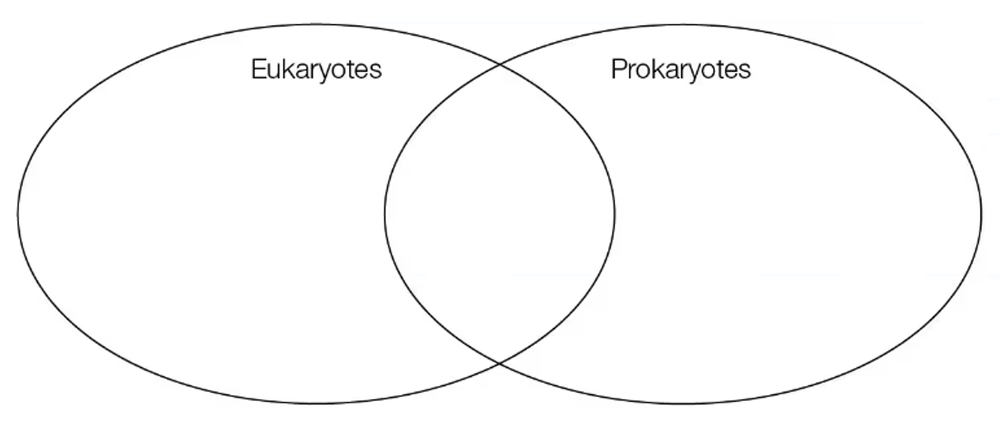
Complete the Venn diagram that compares and contrasts prokaryotes and eukaryotes.
Problem 11
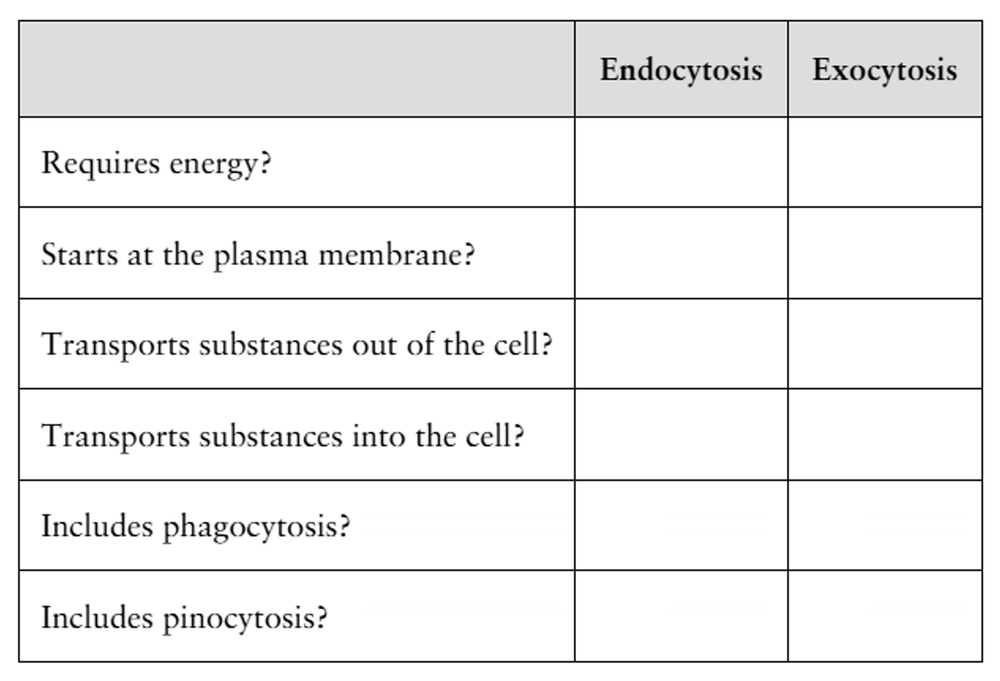
Complete the table by answering yes or no for each question.
Problem 12
Fungal spores can be made by ________. Select all that apply.
a. Binary fission
b. Mitosis
c. Meiosis
d. Asexual reproduction
e. Sexual reproduction
f. Sporogony
Problem 13
Eukaryotic flagella differ from prokaryotic flagella in that:
a. Eukaryotic flagella use a rotary motion to propel the cell.
b. Eukaryotic flagella are made of proteins.
c. Eukaryotic flagella are not enclosed in a membrane.
d. Eukaryotic flagella have a 9 +2 arrangement of microtubules.
Problem 14
Which of the following characteristics regarding eukaryotic organelles supports the endosymbiotic theory? Select all that apply.
a. Eukaryotic ribosomes are 70S just like prokaryotic ribosomes.
b. Mitochondria and chloroplasts have 70S ribosomes like prokaryotes.
c. Mitochondria and chloroplasts are double-membrane organelles similar in size to bacteria.
d. Mitochondria and chloroplasts have their own circular chromosome.
e. Eukaryotes can have cell walls like prokaryotes.
Problem 15
Most fungi grow as a collection of tubular structures called ___________________.
Problem 16
Which of the following statements are true regarding protozoans? Select all that apply.
a. They are unicellular.
b. They have cell walls.
c. They are usually nonphotosynthetic.
d. They are animal-like protists.
e. Some are pathogens.
f. They usually have simple life cycles.
g. They often use sexual and asexual reproduction.
h. They usually lack nuclei.
i. They all have mitochondria.