Ch 40: Quantum Mechanics I: Wave Functions
Young & Freedman Calc - University Physics 14th Edition
Young & Freedman Calc14th EditionUniversity PhysicsISBN: 9780321973610Not the one you use?Change textbook
Chapter 40, Problem 3

An electron is moving as a free particle in the x-x-direction with momentum that has magnitude 4.50×10244.50\(\times\)10^{-24} kg*m/s. Let k2=3k1=3kk_2 = 3k_1 = 3k. At t=0 t = 0, the probability distribution func­tion Ψ(x,t)2|Ψ(x, t)|^2 has a maximum at x=0x = 0.
(a) What is the smallest positive value of xx for which the probability distribution function has a maximum at time t=2πωt=\(\frac{2\pi}{\omega}\), where ω=hk2/2mω = hk^2/2m?
(b) From your result in part (a), what is the average speed with which the probability distribution is moving in the +x+x­-direction?

Verified step by step guidance
1
Step 1: Start by understanding the problem. The electron is described as a free particle, and its wavefunction Ψ(x, t) is a superposition of two plane waves with wave numbers k_1 = k and k_2 = 3k. The probability distribution |Ψ(x, t)|^2 exhibits interference, leading to maxima and minima. The goal is to find the smallest positive x where the probability distribution has a maximum at t = 2π/ω, and then calculate the average speed of the probability distribution in the +x-direction.
Step 2: Write the wavefunction Ψ(x, t) as a superposition of two plane waves: Ψ(x, t) = A[e^(i(kx - ω_1t)) + e^(i(3kx - ω_2t))], where ω_1 = ℏk^2/2m and ω_2 = ℏ(3k)^2/2m. The probability distribution is given by |Ψ(x, t)|^2, which depends on the interference between the two waves.
Step 3: To find the maxima of |Ψ(x, t)|^2, calculate the phase difference between the two waves. The phase difference is Δϕ = (3kx - ω_2t) - (kx - ω_1t) = 2kx - (ω_2 - ω_1)t. For maxima, Δϕ must be an integer multiple of 2π: 2kx - (ω_2 - ω_1)t = 2nπ, where n is an integer.
Step 4: At t = 2π/ω, substitute ω = ℏk^2/2m and calculate ω_2 - ω_1. Using ω_1 = ℏk^2/2m and ω_2 = ℏ(3k)^2/2m, we find ω_2 - ω_1 = ℏ(9k^2 - k^2)/2m = 4ℏk^2/m. Substitute this into the phase condition: 2kx - (4ℏk^2/m)(2π/ω) = 2nπ. Simplify to solve for x in terms of n, k, and other constants.
Step 5: For the smallest positive x, set n = 1 and solve for x. Once x is determined, calculate the average speed of the probability distribution. The average speed is given by v_avg = x/t, where t = 2π/ω. Substitute the expression for x and simplify to find v_avg in terms of k, ℏ, and m.

Verified video answer for a similar problem:

This video solution was recommended by our tutors as helpful for the problem above.
Was this helpful?

Key Concepts

Here are the essential concepts you must grasp in order to answer the question correctly.

Momentum

Momentum is a vector quantity defined as the product of an object's mass and its velocity. In this context, the electron's momentum is given as 4.50 x 10^-24 kg*m/s, indicating its motion in the -x-direction. Understanding momentum is crucial for analyzing the motion of particles and their interactions, especially in quantum mechanics.
Recommended video:
Guided course
05:17
Intro to Momentum

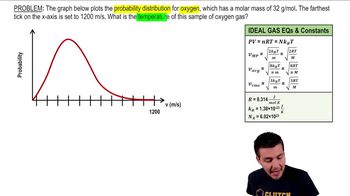
Wave Function and Probability Distribution

In quantum mechanics, the wave function Ψ(x, t) describes the quantum state of a particle, and its squared magnitude |Ψ(x, t)|^2 represents the probability distribution of finding the particle at position x at time t. The maxima of this distribution indicate the most likely positions of the particle, which is essential for solving the problem regarding the position of the electron at a given time.
Recommended video:
Guided course
04:03
Probability Distribution Graph

Angular Frequency (ω)

Angular frequency ω is a measure of how quickly an oscillating system changes its phase, defined as ω = 2π/T, where T is the period. In this problem, ω is related to the wave number k and the mass m of the electron, influencing the time evolution of the wave function. Understanding ω is key to determining the time-dependent behavior of the probability distribution.
Recommended video:
Guided course
05:08
Circumference, Period, and Frequency in UCM
Related Practice
Textbook Question

Let ψ1ψ_1 and ψ2ψ_2 be two solutions of Eq. (40.2340.23) [h22md2ψ(x)dx2+U(x)ψ(x)=Eψ(x)-\(\frac{h^2}{2m}\]\frac{d^2\psi(x)}{dx^2}\)+U\(\left\)(x\(\right\))\(\psi\[\left\)(x\(\right\))=E\(\psi\]\left\)(x\(\right\))] with energies E1E_1 and E2E_2 respectively, where E1E2E_1≠E_2. Is ψ=Aψ1+Bψ2ψ = Aψ_1 + Bψ_2, where AA and BB are nonzero constants, a solution to Eq. (40.2340.23)? Explain your answer.

63
views
Textbook Question

An electron is moving as a free particle in the x-x-direction with momentum that has magnitude 4.50×10244.50\(\times\)10^{-24} kg-m/s. What is the one-­dimensional time-­dependent wave function of the electron?

399
views
Textbook Question

A particle is described by a wave function ψ(x)=Aeαx2\(\psi\)(x)=Ae^{-\(\alpha\) x^2}, where AA and αα are real, positive constants. If the value of αα is increased, what effect does this have on (a) the particle’s uncer­tainty in position and (b) the particle’s uncertainty in momentum? Explain your answers.

59
views
Textbook Question

Consider a wave function given by ψ(x)=Asinkxψ(x) = A sinkx, where k=2π/λ k = 2π/λ and AA is a real constant.

(a) For what values of xx is there the highest probability of finding the particle described by this wave function? Explain.

(b) For which values of xx is the probability zero? Explain.

36
views
Textbook Question

A free particle moving in one dimension has wave function ψ(x,t)=A[ei(kxωt)ei(2kx4ωt)]\(\psi\)(x,t)=A[e^{i\(\left\)(kx-\(\omega\) t\(\right\))}-e^{i(2kx-4\(\omega\) t)}] where kk and vv are positive real constants.

(a) At t=0 t = 0, what are the two smallest positive values of xx for which the probability function ψ(x,t)2 |ψ(x,t)|^2 is a maximum?

(b) Repeat part (a) for time t=2πωt=\(\frac{2\pi}{\omega}\).

78
views