
In an EM wave traveling west, the B field oscillates up and down vertically and has a frequency of 85.0 kHz and an rms strength of 7.75 x 10⁻⁹ T. Determine the frequency and rms strength of the electric field. What is the direction of the electric field oscillations?
Giancoli Douglas 5th edition
Ch. 31 - Maxwell's Equations and Electromagnetic Waves
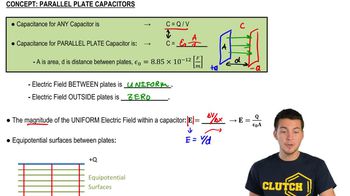
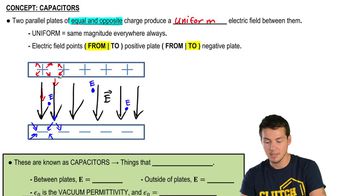
Problem 7bSuppose that a circular parallel-plate capacitor has radius r₀ = 3.0 cm and plate separation d = 5.0 mm. A sinusoidal potential difference V = V₀ sin (2𝝅ft) is applied across the plates, where V₀ = 180 V and f = 60 Hz. Determine the expression for the amplitude B₀(r) of this time-dependent (sinusoidal) field when r ≤ r₀ and when r > r₀.
Verified step by step guidance
Verified video answer for a similar problem:
Key Concepts
Capacitance of a Parallel-Plate Capacitor
Electric Field in a Capacitor
Radial Dependence of Electric Field
Suppose that a circular parallel-plate capacitor has radius r₀ = 3.0 cm and plate separation d = 5.0 mm. A sinusoidal potential difference V = V₀ sin (2𝝅ft) is applied across the plates, where V₀ = 180 V and f = 60 Hz. In the region between the plates, show that the magnitude of the induced magnetic field is given by B = B₀(r) cos (2𝝅ft), where B₀(r) is a function of the radial distance r from the capacitor’s central axis.
Suppose an air-gap capacitor has circular plates of radius r = 2.5 cm and separation d = 1.6 mm. A 68.0-Hz emf, ε = ε₀ cos ωt, is applied to the capacitor. The maximum displacement current is 35 μA. Determine the maximum value of dΦE/dt between the plates. Neglect fringing.
(III) (a) When a circular parallel-plate capacitor is being charged as in Example 31–1, show that the Poynting vector points radially inward toward the center of the capacitor, parallel to the plates.
(a) When a circular parallel-plate capacitor is being charged as in Example 31–1, show that the Poynting vector points radially inward toward the center of the capacitor, parallel to the plates.
(b) Integrate over the cylindrical boundary of the capacitor gap to show that the rate at which energy enters the capacitor is equal to the rate at which electrostatic energy is being stored in the electric field of the capacitor (Section 24–4). Ignore fringing of .
Suppose an air-gap capacitor has circular plates of radius r = 2.5 cm and separation d = 1.6 mm. A 68.0-Hz emf, ε = ε₀ cos ωt, is applied to the capacitor. The maximum displacement current is 35 μA. Determine the value of ε₀. Neglect fringing.