Ch. 25 - Electric Current and Resistance
Giancoli Douglas - Physics for Scientists and Engineers 5th edition
Giancoli Douglas5th editionPhysics for Scientists and EngineersISBN: 9780137488179Not the one you use?Change textbook
Chapter 24, Problem 15

Neglect the internal resistance of a battery unless the problem refers to it. Ten 7.0-W Christmas tree lights are connected in series to each other and to a 120-V source. What is the resistance of each bulb?

Verified step by step guidance
1
Determine the total power of the Christmas tree lights. Since there are 10 bulbs, each rated at 7.0 W, the total power is given by: P=10×7.0 W.
Use the formula for power in terms of voltage and resistance for the entire circuit: P=V2R, where V is the total voltage (120 V) and R is the total resistance of the circuit.
Rearrange the formula to solve for the total resistance: R=V2P. Substitute the values for V=120 and P=70 W (calculated in step 1).
Since the bulbs are connected in series, the total resistance is the sum of the individual resistances. Let Ri represent the resistance of each bulb. Then, R=10×Ri. Rearrange to solve for Ri: Ri=R10.
Substitute the total resistance value (calculated in step 3) into the equation from step 4 to find the resistance of each bulb.

Verified video answer for a similar problem:

This video solution was recommended by our tutors as helpful for the problem above.
Video duration:
3m
Was this helpful?

Key Concepts

Here are the essential concepts you must grasp in order to answer the question correctly.

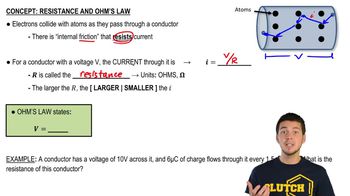
Ohm's Law

Ohm's Law states that the current (I) flowing through a conductor between two points is directly proportional to the voltage (V) across the two points and inversely proportional to the resistance (R) of the conductor. It is mathematically expressed as V = I * R. This fundamental principle is essential for analyzing electrical circuits and calculating resistance, current, and voltage.
Recommended video:
Guided course
03:07
Resistance and Ohm's Law

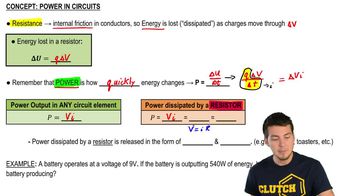
Power in Electrical Circuits

The power (P) consumed by an electrical device is defined as the rate at which it converts electrical energy into another form of energy, such as light or heat. It is calculated using the formula P = V * I, where V is voltage and I is current. In this problem, the power rating of the Christmas tree lights helps determine the total power consumed and, subsequently, the resistance of each bulb.
Recommended video:
Guided course
06:18
Power in Circuits

Series Circuits

In a series circuit, components are connected end-to-end, so the same current flows through each component. The total resistance in a series circuit is the sum of the individual resistances. This concept is crucial for understanding how the voltage from the source is distributed across the connected bulbs, allowing for the calculation of the resistance of each bulb based on the total voltage and power consumed.
Recommended video:
Guided course
05:55
LRC Circuits in Series
Related Practice
Textbook Question

(a) What is the current in the 13-Ω heating element of a 240-V clothes dryer?

(b) How much charge passes through the element in 15 min? (Assume direct current.)

1260
views

Textbook Question

A 4.5-V battery is connected to a bulb whose resistance is 2.3 Ω. How many electrons leave the battery per minute?

1184
views
Textbook Question

The filament of an incandescent lightbulb has a resistance of 12 Ω at 20°C and 140 Ω when hot.

(a) Calculate the temperature of the filament when it is hot, and take into account the change in length and area of the filament due to thermal expansion (assume tungsten for which the thermal expansion coefficient is ≈ 5.5 10⁻⁶ C°⁻¹ ).

(b) In this temperature range, what is the percentage change in resistance due to thermal expansion, and what is the percentage change in resistance due solely to the change in ρ? Use Eq. 25–5.

1045
views
Textbook Question

A 12-V battery causes a current of 0.50 A through a resistor. How many joules of energy does the battery lose in a minute?

1134
views
Textbook Question

A rectangular solid made of carbon has sides of lengths 1.0 cm, 2.0 cm, and 4.0 cm, lying along the x, y, and z axes, respectively (Fig. 25–36). Determine the resistance for current that passes through the solid in the y direction, (Assume the resistivity is ρ = 3.0 x 10⁻⁵ Ω•m).

1367
views
Textbook Question

The heating element of an electric oven is designed to produce 3.1 kW of heat when connected to a 240-V source. What must be the resistance of the element?

1082
views