
How much energy would be required to break a helium nucleus into its constituents, two protons and two neutrons? The rest masses of a proton (including an electron), a neutron, and neutral helium are, respectively, 1.00783 u, 1.00867 u, and 4.00260 u. (This energy difference is called the total binding energy of the nucleus.)
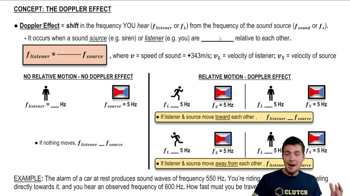
A quasar emits familiar hydrogen lines whose wavelengths are 8.5% longer than what we measure in the laboratory.
(a) Using the Doppler formula for light, estimate the speed of this quasar.
(b) What result would you obtain if you used the “classical” Doppler shift discussed in Chapter 16?
Verified step by step guidance
Verified video answer for a similar problem:
Key Concepts
Doppler Effect
Redshift
Classical vs. Relativistic Doppler Shift
A spaceship and its occupants have a total mass of 160,000 kg. The occupants would like to travel to a star that is 32 light-years away at a speed of 0.70c. To accelerate, the engine of the spaceship changes mass directly to energy.
(a) Estimate how much mass will be converted to energy to accelerate the spaceship to this speed.
(b) Assuming the acceleration is rapid, so the speed for the entire trip can be taken to be 0.70c, determine how long the trip will take according to the astronauts on board.
For a 1.0-kg mass, make a plot of the kinetic energy as a function of speed for speeds from 0 to 0.9c, using both the classical formula ( K = 1/2 mv²) and the correct relativistic formula ( K = ( γ -1)mc²).
Using Example 36–2 as a guide, show that for objects that move slowly in comparison to c, the length contraction formula is roughly ℓ ≈ ℓ₀ (1 - 1/2 v²/c²) . Use this approximation to find the “length shortening” ∆ℓ = ℓ₀ - ℓ of the train in Example 36–6 if the train travels at 100 km/h (rather than 0.92c).
A pi meson of mass mπ decays at rest into a muon (mass mμ) and a neutrino of negligible or zero mass. Show that the kinetic energy of the muon is Kμ = (mπ - mμ)² c² / (2mπ).
Two protons, each having a speed of 0.945c in the laboratory, are moving toward each other. Determine (a) the momentum of each proton in the laboratory, (b) the total momentum of the two protons in the laboratory, and (c) the momentum of one proton as seen by the other proton.
