
Ch. 35 - Diffraction
Giancoli Douglas - Physics for Scientists and Engineers 5th edition
Giancoli Douglas5th editionPhysics for Scientists and EngineersISBN: 9780137488179Not the one you use?Change textbook
Chapter 34, Problem 35

A 3800-slit/cm grating produces a third-order fringe at a 35.0° angle. What wavelength of light is being used?

Verified step by step guidance
1
Identify the formula for diffraction grating: \( d \sin \theta = m \lambda \), where \( d \) is the distance between adjacent slits (grating spacing), \( \theta \) is the diffraction angle, \( m \) is the order of the fringe, and \( \lambda \) is the wavelength of light.
Convert the given grating value from slits per centimeter to grating spacing \( d \) in meters. Since there are 3800 slits per centimeter, \( d = \frac{1}{3800 \times 10^2} \) meters.
Substitute the known values into the formula: \( d \sin \theta = m \lambda \). Here, \( d \) is the grating spacing calculated in the previous step, \( \theta = 35.0^\circ \), and \( m = 3 \) (third-order fringe).
Rearrange the formula to solve for \( \lambda \): \( \lambda = \frac{d \sin \theta}{m} \).
Substitute the values of \( d \), \( \sin \theta \), and \( m \) into the rearranged formula to calculate the wavelength \( \lambda \). Ensure that \( \sin \theta \) is calculated using the angle in degrees.

Verified video answer for a similar problem:

This video solution was recommended by our tutors as helpful for the problem above.
Video duration:
3m
Was this helpful?

Key Concepts

Here are the essential concepts you must grasp in order to answer the question correctly.

Diffraction Grating

A diffraction grating is an optical component with a periodic structure that disperses light into its component wavelengths. It consists of multiple slits, which cause constructive and destructive interference of light waves. The angle at which light is diffracted depends on the wavelength and the spacing of the slits, making it essential for analyzing light spectra.
Recommended video:

Order of Diffraction

The order of diffraction refers to the integer (n) that indicates the number of wavelengths by which the path difference between light waves from adjacent slits differs. For example, the third-order fringe corresponds to n=3. Higher orders occur at larger angles and are associated with longer path differences, allowing for the observation of multiple wavelengths.
Recommended video:

Wavelength Calculation

The wavelength of light can be calculated using the grating equation, which is given by d sin(θ) = nλ, where d is the distance between slits, θ is the angle of diffraction, n is the order of the fringe, and λ is the wavelength. This relationship allows us to determine the wavelength of light based on the angle at which a specific order of fringe appears.
Recommended video:
Guided course
05:42
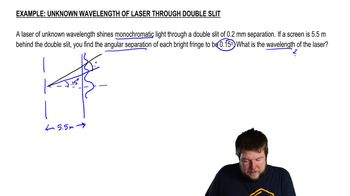
Unknown Wavelength of Laser through Double Slit
Related Practice
Textbook Question

(III) Derive an expression for the intensity in the interference pattern for three equally spaced slits. Express in terms of δ = 2πd sin θ / λ where d is the distance between adjacent slits and assume the slit width D ≈ λ . Show that there is only one secondary maximum between principal peaks.

1551
views
Textbook Question

The nearest neighboring star to the Sun is about 4 light-years away. If a planet happened to be orbiting this star at an orbital radius equal to that of the Earth–Sun distance, what minimum diameter would an Earth-based telescope’s aperture have to be in order to obtain an image that resolved this star–planet system? Assume the light emitted by the star and planet has a wavelength of 550 nm.

86
views
Textbook Question

A diffraction grating has 6.5 x 10⁵ slits/m. Find the angular spread in the second-order spectrum between red light of wavelength 7.0 x 10⁻⁷ m and blue light of wavelength 4.5 x 10⁻⁷ m.

82
views
Textbook Question

When driving at night, your eyes’ pupils have dilated to a 7.5-mm diameter. If your vision is diffraction limited, what would be the greatest distance at which you could resolve the two headlights of an oncoming car, which are spaced 1.5 m apart? Assume a wavelength of 550 nm for the light.

69
views
Textbook Question

Suppose the angles measured in Problem 42 were produced when the spectrometer (but not the source) was submerged in water. What then would be the wavelengths (in air)?

1417
views
Textbook Question

Show that the second- and third-order spectra of white light produced by a diffraction grating always overlap. What wavelengths overlap?

43
views