
Ch. 08 - Conservation of Energy
Giancoli Douglas - Physics for Scientists and Engineers 5th edition
Giancoli Douglas5th editionPhysics for Scientists and EngineersISBN: 9780137488179Not the one you use?Change textbook
Chapter 8, Problem 44a

Determine the escape velocity from the Sun for an object at the Sun’s surface ( r = 7.0 x 10⁵ km , M = 2.0 x 10³⁰ kg).

Verified step by step guidance
1
Step 1: Recall the formula for escape velocity, which is derived from the conservation of energy. The escape velocity \( v_e \) is given by \( v_e = \sqrt{\frac{2GM}{r}} \), where \( G \) is the gravitational constant \( 6.674 \times 10^{-11} \ \text{m}^3 \text{kg}^{-1} \text{s}^{-2} \), \( M \) is the mass of the Sun, and \( r \) is the distance from the center of the Sun to the object.
Step 2: Convert the given radius \( r \) from kilometers to meters. Since \( 1 \ \text{km} = 1000 \ \text{m} \), multiply \( r = 7.0 \times 10^5 \ \text{km} \) by \( 1000 \) to get \( r = 7.0 \times 10^8 \ \text{m} \).
Step 3: Substitute the given values into the escape velocity formula. Use \( G = 6.674 \times 10^{-11} \ \text{m}^3 \text{kg}^{-1} \text{s}^{-2} \), \( M = 2.0 \times 10^{30} \ \text{kg} \), and \( r = 7.0 \times 10^8 \ \text{m} \). The formula becomes \( v_e = \sqrt{\frac{2 \cdot (6.674 \times 10^{-11}) \cdot (2.0 \times 10^{30})}{7.0 \times 10^8}} \).
Step 4: Simplify the numerator \( 2 \cdot G \cdot M \) and the denominator \( r \) separately. Then divide the numerator by the denominator to find the value inside the square root.
Step 5: Take the square root of the result from Step 4 to find the escape velocity \( v_e \). Ensure the units are consistent throughout the calculation, and the final velocity will be in meters per second (m/s).

Verified video answer for a similar problem:

This video solution was recommended by our tutors as helpful for the problem above.
Video duration:
3m
Was this helpful?

Key Concepts

Here are the essential concepts you must grasp in order to answer the question correctly.

Escape Velocity

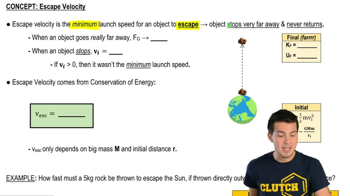
Escape velocity is the minimum speed an object must reach to break free from the gravitational pull of a celestial body without any additional propulsion. It is derived from the balance between kinetic energy and gravitational potential energy, and is given by the formula v = √(2GM/r), where G is the gravitational constant, M is the mass of the body, and r is the radius from the center of the mass.
Recommended video:
Guided course
7:27
Escape Velocity

Gravitational Constant (G)

The gravitational constant, denoted as G, is a fundamental physical constant that quantifies the strength of gravitational attraction between two masses. Its value is approximately 6.674 × 10⁻¹¹ N(m/kg)². This constant is crucial in calculations involving gravitational forces and escape velocity, as it directly influences the gravitational potential energy of an object near a massive body.
Recommended video:
Guided course
08:59
Phase Constant of a Wave Function

Mass and Radius of the Sun

The mass and radius of the Sun are essential parameters in calculating escape velocity. The Sun's mass (approximately 2.0 x 10³⁰ kg) determines the strength of its gravitational field, while its radius (about 7.0 x 10⁵ km) defines the distance from its center at which the escape velocity is being calculated. These values are critical for applying the escape velocity formula accurately.
Recommended video:
Guided course
06:18
Calculating Radius of Nitrogen
Related Practice
Textbook Question

A driver notices that her 950-kg car, when in neutral, slows down from 95 km/h to 65 km/h in about 7.0 s on a flat horizontal road. Approximately what power (watts and hp) is needed to keep the car traveling at a constant 80 km/h?

1984
views
Textbook Question

An 85-kg football player traveling 5.0 m/s is stopped in 1.0 s by a tackler. What average power is required to stop him?

1698
views
Textbook Question

A spring ( k = 75 N/m) has an equilibrium length of 1.00 m. The spring is compressed to a length of 0.50 m and a mass of 2.0 kg is placed at its free end on a frictionless slope which makes an angle of 41° with respect to the horizontal (Fig. 8–41). The spring is then released. Now the incline has a coefficient of kinetic friction μₖ. If the block, attached to the spring, is observed to stop just as it reaches the spring’s equilibrium position, what is the coefficient of friction μₖ?

866
views
Textbook Question

Early test flights for the space shuttle used a “glider” (mass of 980 kg including pilot). After a horizontal launch at 480 km/h at a height of 3200 m, the glider eventually landed at sea level with a speed of 210 km/h. What would its landing speed have been in the absence of air resistance?

1583
views
Textbook Question

Determine the escape velocity from the Sun for an object at the average distance of the Earth (1.50 x 10⁸ km). Compare (give factor for each) to the speed of the Earth in its orbit.

1712
views
Textbook Question

A spring ( k = 75 N/m) has an equilibrium length of 1.00 m. The spring is compressed to a length of 0.50 m and a mass of 2.0 kg is placed at its free end on a frictionless slope which makes an angle of 41° with respect to the horizontal (Fig. 8–41). The spring is then released. If the mass is attached to the spring, how far up the slope will the mass move before coming to rest?

1010
views