
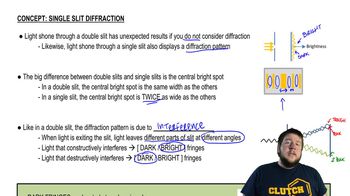
Monochromatic light falls on a slit that is 2.60 x 10⁻³ mm wide. If the angle between the first dark fringes on either side of the central maximum is 29.0° (dark fringe to dark fringe), what is the wavelength of the light used?
(a) Explain why the secondary maxima in the single-slit diffraction pattern do not occur precisely at β/2 = (m + 1/2)π where m = 1, 2, 3, ... .
(b) By differentiating Eq. 35–7 with respect to β show that the secondary maxima occur when β/2 satisfies the relation tan(β/2) = β/2.
(c) Carefully and precisely plot the curves y = β/2 and y = tan β/2. From their intersections, determine the values of β for the first and second secondary maxima. What is the percent difference from β/2 = (m + 1/2)π?
Verified step by step guidance
Verified video answer for a similar problem:
Key Concepts
Single-Slit Diffraction
Maxima and Minima Conditions
Graphical Analysis of Functions
Explain why the secondary maxima in the single-slit diffraction pattern do not occur precisely at β/2 = (m + 1/2)π where m = 1, 2, 3, ... Carefully and precisely plot the curves y = β/2 and y = tan β/2. From their intersections, determine the values of β for the first and second secondary maxima. What is the percent difference from β/2 = (m + 1/2)π?
In a double-slit experiment, let d = 5.00D = 40.0λ. Compare (as a ratio) the intensity of the third-order interference maximum with that of the zero-order maximum.
Light of wavelength 580 nm falls on a slit that is 3.50 x 10⁻³ mm wide. Estimate how far the first brightest diffraction fringe is from the strong central maximum if the screen is 10.0 m away.
Monochromatic light of wavelength 633 nm falls on a slit. If the angle between the first bright fringes on either side of the central maximum is 32°, estimate the slit width.
Two 0.010-mm-wide slits are 0.030 mm apart (center to center). Determine (a) the spacing between interference fringes for 520-nm light on a screen 1.0 m away and (b) the distance between the two diffraction minima on either side of the central maximum of the envelope.
