
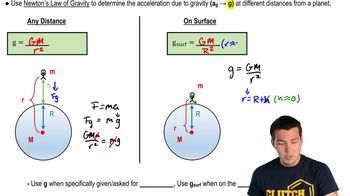
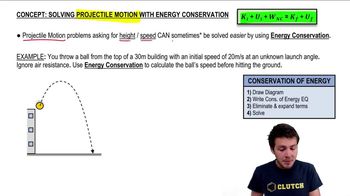
You throw a glob of putty straight up toward the ceiling, which is m above the point where the putty leaves your hand. The initial speed of the putty as it leaves your hand is m/s. What is the speed of the putty just before it strikes the ceiling?
A tennis ball on Mars, where the acceleration due to gravity is and air resistance is negligible, is hit directly upward and returns to the same level s later. How fast was it moving just after it was hit?
Verified step by step guidance
Verified video answer for a similar problem:
Key Concepts
Acceleration due to Gravity
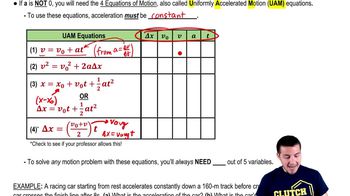
Kinematic Equations
Symmetry of Projectile Motion
You throw a glob of putty straight up toward the ceiling, which is m above the point where the putty leaves your hand. The initial speed of the putty as it leaves your hand is m/s. How much time from when it leaves your hand does it take the putty to reach the ceiling?
A tennis ball on Mars, where the acceleration due to gravity is and air resistance is negligible, is hit directly upward and returns to the same level s later. How high above its original point did the ball go?
A lunar lander is making its descent to Moon Base I (Fig. E). The lander descends slowly under the retro-thrust of its descent engine. The engine is cut off when the lander is m above the surface and has a downward speed of m/s. With the engine off, the lander is in free fall. What is the speed of the lander just before it touches the surface? The acceleration due to gravity on the moon is m/s.
A brick is dropped (zero initial speed) from the roof of a building. The brick strikes the ground in s. You may ignore air resistance, so the brick is in free fall. How tall, in meters, is the building?
A brick is dropped (zero initial speed) from the roof of a building. The brick strikes the ground in s. You may ignore air resistance, so the brick is in free fall. What is the magnitude of the brick's velocity just before it reaches the ground?
