
Pearson+ LogoPearson+ Logo
Ch 04: Newton's Laws of Motion
Young & Freedman Calc - University Physics 14th Edition
Young & Freedman Calc14th EditionUniversity PhysicsISBN: 9780321973610Not the one you use?Change textbook
Chapter 4, Problem 27b

A ball is hanging from a long string that is tied to the ceiling of a train car traveling eastward on horizontal tracks. An observer inside the train car sees the ball hang motionless. Draw a clearly labeled free-body diagram for the ball if the train is speeding up uniformly. Is the net force on the ball zero in either case? Explain.

Verified step by step guidance
1
Step 1: Begin by identifying the forces acting on the ball. The ball is subject to two primary forces: (1) the gravitational force acting downward, which is the weight of the ball, and (2) the tension force in the string, which acts along the string and keeps the ball suspended.
Step 2: Consider the scenario where the train is speeding up uniformly. In this case, the train is accelerating eastward. Due to this acceleration, the ball will experience a pseudo-force (inertial force) directed westward relative to the train's frame of reference. This pseudo-force arises because the train is a non-inertial reference frame.
Step 3: Draw the free-body diagram for the ball. Represent the gravitational force as a downward arrow labeled \( F_g = m g \), where \( m \) is the mass of the ball and \( g \) is the acceleration due to gravity. Represent the tension force as an arrow along the string, angled slightly westward to counteract the pseudo-force. Label the pseudo-force as \( F_p = m a \), where \( a \) is the acceleration of the train.
Step 4: Analyze the net force on the ball. The ball is motionless relative to the train, meaning it is in equilibrium in the train's frame of reference. The tension force in the string has both vertical and horizontal components. The vertical component of the tension balances the gravitational force, and the horizontal component balances the pseudo-force. Thus, the net force on the ball is zero in the train's frame of reference.
Step 5: Conclude that the net force on the ball is not zero in the inertial (ground) frame of reference because the ball is accelerating eastward along with the train. However, in the train's non-inertial frame, the net force is zero because the pseudo-force balances the horizontal component of the tension.

Verified video answer for a similar problem:

This video solution was recommended by our tutors as helpful for the problem above.
Video duration:
2m
Was this helpful?

Key Concepts

Here are the essential concepts you must grasp in order to answer the question correctly.

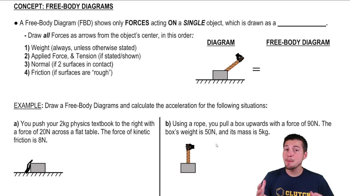
Free-Body Diagram

A free-body diagram is a graphical representation used to visualize the forces acting on an object. In this case, it would illustrate the gravitational force acting downward on the ball and the tension in the string acting upward. This diagram helps in analyzing the net force and understanding the motion of the object.
Recommended video:
Guided course
08:42
Free-Body Diagrams

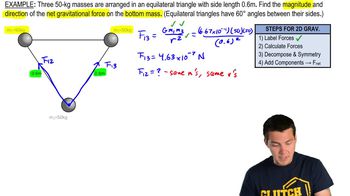
Net Force

The net force is the vector sum of all the forces acting on an object. It determines the object's acceleration according to Newton's second law (F=ma). If the net force is zero, the object remains in its current state of motion; if not, it will accelerate in the direction of the net force.
Recommended video:
Guided course
06:28
Finding Net Forces in 2D Gravitation

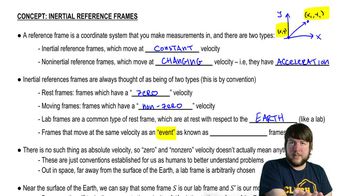
Inertial Reference Frame

An inertial reference frame is a frame of reference in which an object either remains at rest or moves at a constant velocity unless acted upon by a net external force. In the context of the train accelerating, the observer inside the train experiences a pseudo-force due to the acceleration, affecting the perceived forces on the ball.
Recommended video:
Guided course
14:10
Inertial Reference Frames