
A hockey puck with mass kg is at rest at the origin () on the horizontal, frictionless surface of the rink. At time a player applies a force of N to the puck, parallel to the -axis; she continues to apply this force until s. If the same force is again applied at s, what are the position and speed of the puck at s?
A small -kg rocket burns fuel that exerts a time-varying upward force on the rocket (assume constant mass) as the rocket moves upward from the launch pad. This force obeys the equation . Measurements show that at , the force is N, and at the end of the first s, it is N. Find the constants and , including their SI units.
Verified step by step guidance
Verified video answer for a similar problem:
Key Concepts
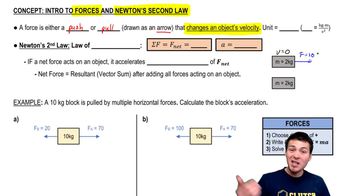
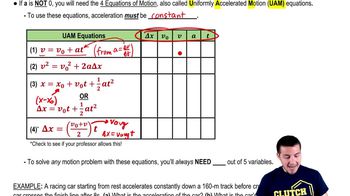
Newton's Second Law of Motion
Force Equation
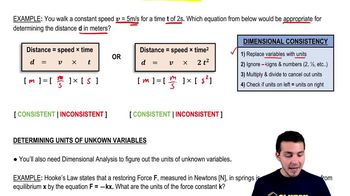
SI Units and Dimensional Analysis
A -kg experimental cart undergoes an acceleration in a straight line (the -axis). The graph in Fig. E shows this acceleration as a function of time. Find the maximum net force on this cart. When does this maximum force occur?
A -kg experimental cart undergoes an acceleration in a straight line (the -axis). The graph in Fig. E shows this acceleration as a function of time. During what times is the net force on the cart a constant?
An astronaut's pack weighs N when she is on the earth but only N when she is at the surface of a moon. What is the acceleration due to gravity on this moon?
At the surface of Jupiter's moon Io, the acceleration due to gravity is m/s2. A watermelon weighs N at the surface of the earth. What is the watermelon's mass on the earth's surface?
At the surface of Jupiter's moon Io, the acceleration due to gravity is m/s2. A watermelon weighs N at the surface of the earth. What would be its mass and weight on the surface of Io?
