Pearson+ LogoPearson+ Logo
Ch 07: Potential Energy & Conservation
Young & Freedman Calc - University Physics 14th Edition
Young & Freedman Calc14th EditionUniversity PhysicsISBN: 9780321973610Not the one you use?Change textbook
Chapter 7, Problem 12

Tarzan, in one tree, sights Jane in another tree. He grabs the end of a vine with length 2020 m that makes an angle of 45°45° with the vertical, steps off his tree limb, and swings down and then up to Jane's open arms. When he arrives, his vine makes an angle of 30°30° with the vertical. Determine whether he gives her a tender embrace or knocks her off her limb by calculating Tarzan's speed just before he reaches Jane. Ignore air resistance and the mass of the vine.

Verified step by step guidance
1
Step 1: Identify the energy conservation principle. Since air resistance and the mass of the vine are ignored, we can use the conservation of mechanical energy. Tarzan's potential energy at the starting point is converted into kinetic energy and potential energy at the final point.
Step 2: Write the expression for Tarzan's potential energy at the starting point. The height difference between Tarzan's initial position and the lowest point of the swing can be calculated using the vine length and the angle with the vertical. Use the formula for height: \( h = L(1 - \cos\theta) \), where \( L \) is the vine length and \( \theta \) is the angle with the vertical.
Step 3: Write the expression for Tarzan's potential energy at the final point. Similarly, calculate the height difference between Tarzan's final position and the lowest point of the swing using \( h = L(1 - \cos\theta) \), where \( \theta \) is the final angle with the vertical.
Step 4: Apply the conservation of mechanical energy. The total mechanical energy at the starting point (potential energy) is equal to the total mechanical energy at the final point (kinetic energy + potential energy). Use the equation: \( m g h_{initial} = \frac{1}{2} m v^2 + m g h_{final} \), where \( m \) is Tarzan's mass, \( g \) is the acceleration due to gravity, \( h_{initial} \) is the initial height, \( h_{final} \) is the final height, and \( v \) is Tarzan's speed just before reaching Jane.
Step 5: Solve for Tarzan's speed \( v \). Rearrange the equation to isolate \( v \): \( v = \sqrt{2 g (h_{initial} - h_{final})} \). Substitute the values for \( g \), \( h_{initial} \), and \( h_{final} \) to calculate Tarzan's speed. Ensure all units are consistent.

Verified video answer for a similar problem:

This video solution was recommended by our tutors as helpful for the problem above.
Video duration:
8m
Was this helpful?

Key Concepts

Here are the essential concepts you must grasp in order to answer the question correctly.

Conservation of Energy

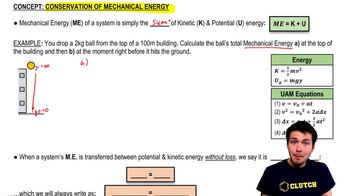
The principle of conservation of energy states that the total energy in a closed system remains constant. In the context of Tarzan's swing, potential energy at the highest point converts to kinetic energy at the lowest point. This relationship allows us to calculate Tarzan's speed just before he reaches Jane by equating the potential energy lost to the kinetic energy gained.
Recommended video:
Guided course
06:24
Conservation Of Mechanical Energy

Kinematics of Circular Motion

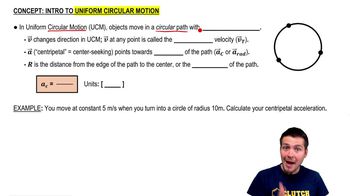
When Tarzan swings on the vine, he undergoes circular motion. The angle of the vine with the vertical affects the radius of the circular path and the forces acting on him. Understanding the kinematics involved, including the relationship between angular displacement and linear speed, is crucial for determining his speed at different points in the swing.
Recommended video:
Guided course
03:48
Intro to Circular Motion

Forces and Acceleration

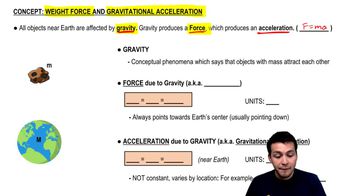
The forces acting on Tarzan during his swing include gravitational force and tension in the vine. As he swings down, gravity accelerates him, and the tension provides the necessary centripetal force to keep him moving in a circular path. Analyzing these forces helps in calculating the net acceleration and ultimately Tarzan's speed just before he reaches Jane.
Recommended video:
Guided course
07:32
Weight Force & Gravitational Acceleration