
Ch 09: Rotation of Rigid Bodies
Chapter 9, Problem 36

A wheel is turning about an axis through its center with constant angular acceleration. Starting from rest, at t = 0, the wheel turns through 8.20 revolutions in 12.0 s. At t = 12.0 s the kinetic energy of the wheel is 36.0 J. For an axis through its center, what is the moment of inertia of the wheel?

Verified step by step guidance
1
Step 1: Convert the number of revolutions into radians. Since one revolution corresponds to \(2\pi\) radians, multiply the given number of revolutions (8.20) by \(2\pi\) to find the total angular displacement \(\theta\) in radians.
Step 2: Use the kinematic equation for rotational motion \(\theta = \omega_0 t + \frac{1}{2} \alpha t^2\), where \(\omega_0\) is the initial angular velocity (0 rad/s, since the wheel starts from rest), \(\alpha\) is the angular acceleration, and \(t\) is the time. Substitute \(\theta\) and \(t\) to solve for \(\alpha\).
Step 3: Calculate the angular velocity \(\omega\) at \(t = 12.0\,\text{s}\) using the equation \(\omega = \omega_0 + \alpha t\). Substitute \(\omega_0 = 0\), \(\alpha\) (from Step 2), and \(t = 12.0\,\text{s}\) to find \(\omega\).
Step 4: Use the rotational kinetic energy formula \(K = \frac{1}{2} I \omega^2\), where \(K\) is the kinetic energy (36.0 J), \(I\) is the moment of inertia, and \(\omega\) is the angular velocity (from Step 3). Rearrange the formula to solve for \(I\).
Step 5: Substitute the values of \(K\) and \(\omega\) into the equation \(I = \frac{2K}{\omega^2}\) to calculate the moment of inertia \(I\).

Verified video answer for a similar problem:

This video solution was recommended by our tutors as helpful for the problem above.
Video duration:
7m
Was this helpful?

Key Concepts

Here are the essential concepts you must grasp in order to answer the question correctly.

Angular Acceleration

Angular acceleration is the rate of change of angular velocity over time. It is a vector quantity that indicates how quickly an object is rotating faster or slower. In this problem, the wheel experiences constant angular acceleration, which means its angular velocity increases uniformly from rest. This concept is crucial for determining the final angular velocity after a given time period.
Recommended video:
Guided course
12:12
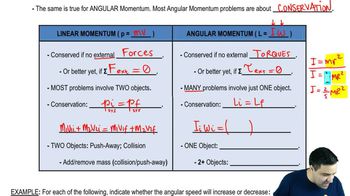
Conservation of Angular Momentum

Kinetic Energy of Rotation

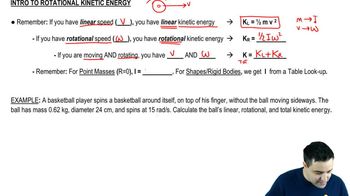
The kinetic energy of a rotating object is given by the formula KE = 0.5 * I * ω², where I is the moment of inertia and ω is the angular velocity. This relationship shows how the energy of a rotating body depends on both its mass distribution (moment of inertia) and its rotational speed. In this question, knowing the kinetic energy at a specific time allows us to relate it to the moment of inertia once we find the angular velocity.
Recommended video:
Guided course
06:07
Intro to Rotational Kinetic Energy

Moment of Inertia

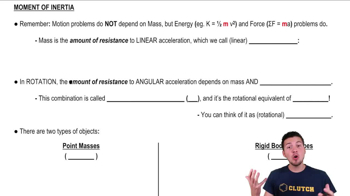
Moment of inertia is a measure of an object's resistance to changes in its rotational motion, analogous to mass in linear motion. It depends on the mass distribution relative to the axis of rotation. For the wheel in this problem, calculating the moment of inertia is essential to relate the kinetic energy and angular velocity, allowing us to solve for the unknown quantity using the provided data.
Recommended video:
Guided course
11:47
Intro to Moment of Inertia
Related Practice
Textbook Question

A wagon wheel is constructed as shown in Fig. E9.33. The radius of the wheel is 0.300 m, and the rim has mass 1.40 kg. Each of the eight spokes that lie along a diameter and are 0.300 m long has mass 0.280 kg. What is the moment of inertia of the wheel about an axis through its center and perpendicular to the plane of the wheel? (Use Table 9.2.)

1575
views
Textbook Question

An airplane propeller is 2.08 m in length (from tip to tip) with mass 117 kg and is rotating at 2400 rpm (rev/min) about an axis through its center. You can model the propeller as a slender rod.

(a) What is its rotational kinetic energy?

(b) Suppose that, due to weight constraints, you had to reduce the propeller's mass to 75.0% of its original mass, but you still needed to keep the same size and kinetic energy. What would its angular speed have to be, in rpm?

2297
views
Textbook Question

A compound disk of outside diameter 140.0 cm is made up of a uniform solid disk of radius 50.0 cm and area density 3.00 g/cm2 surrounded by a concentric ring of inner radius 50.0 cm, outer radius 70.0 cm, and area density 2.00 g/cm2. Find the moment of inertia of this object about an axis perpendicular to the plane of the object and passing through its center.

1331
views
Textbook Question

A uniform sphere with mass 28.028.0 kg and radius 0.3800.380 m is rotating at constant angular velocity about a stationary axis that lies along a diameter of the sphere. If the kinetic energy of the sphere is 236236 J, what is the tangential velocity of a point on the rim of the sphere?

1911
views
Textbook Question

The flywheel of a gasoline engine is required to give up 500 J of kinetic energy while its angular velocity decreases from 650 rev/min to 520 rev/min. What moment of inertia is required?

2267
views
Textbook Question

A uniform 2.00-m ladder of mass 9.00 kg is leaning against a vertical wall while making an angle of 53.0° with the floor. A worker pushes the ladder up against the wall until it is vertical. What is the increase in the gravitational potential energy of the ladder?

626
views