Ch 10: Dynamics of Rotational Motion
Chapter 10, Problem 38a

Calculate the magnitude of the angular momentum of the earth in a circular orbit around the sun. Is it reasonable to model it as a particle? Consult Appendix E and the astronomical data in Appendix F

Verified step by step guidance
1
Identify the formula for angular momentum of a particle in circular motion: \( L = mvr \), where \( m \) is the mass, \( v \) is the velocity, and \( r \) is the radius of the orbit.
Determine the mass of the Earth \( m \) from Appendix E or F. This is typically given as \( 5.97 \times 10^{24} \) kg.
Find the average distance from the Earth to the Sun, which is the radius \( r \) of the Earth's orbit. This is approximately \( 1.496 \times 10^{11} \) meters.
Calculate the orbital velocity \( v \) of the Earth. Use the formula \( v = \frac{2\pi r}{T} \), where \( T \) is the orbital period of the Earth (1 year or \( 365.25 \times 24 \times 3600 \) seconds).
Substitute the values of \( m \), \( v \), and \( r \) into the angular momentum formula \( L = mvr \) to find the magnitude of the Earth's angular momentum. Consider whether treating the Earth as a particle is reasonable by comparing the size of the Earth to the size of its orbit.

Verified video answer for a similar problem:

This video solution was recommended by our tutors as helpful for the problem above.
Video duration:
4m
Was this helpful?

Key Concepts

Here are the essential concepts you must grasp in order to answer the question correctly.

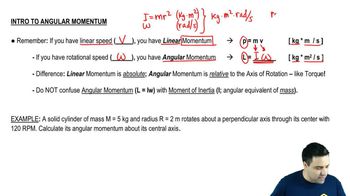
Angular Momentum

Angular momentum is a measure of the quantity of rotation of an object and is a product of its moment of inertia and angular velocity. For an object in circular motion, like Earth orbiting the Sun, it can be calculated using L = mvr, where m is mass, v is velocity, and r is the radius of the orbit. It is a conserved quantity in a closed system, meaning it remains constant if no external torque acts on the system.
Recommended video:
Guided course
06:18
Intro to Angular Momentum

Modeling Earth as a Particle

Modeling Earth as a particle simplifies calculations by treating it as a point mass located at its center of mass. This approximation is reasonable when considering large-scale motions, such as Earth's orbit around the Sun, where the size of Earth is negligible compared to the vast distances involved. This simplification allows us to focus on the motion of Earth's center of mass without considering its rotation or internal structure.
Recommended video:
Guided course
9:26
Gravitational Force Inside the Earth

Astronomical Data

Astronomical data provides essential parameters such as Earth's mass, the radius of its orbit, and its orbital velocity, which are crucial for calculating angular momentum. These values are typically found in appendices of physics textbooks or astronomical databases and are necessary for precise calculations. Accurate data ensures that the computed angular momentum reflects the true dynamics of Earth's motion around the Sun.
Recommended video:
Guided course
05:19
Energy & Torque of Dipole Moments
Related Practice
Textbook Question

A 2.00-kg rock has a horizontal velocity of magnitude 12.0 m/s when it is at point P in Fig. E10.35. At this instant, what are the magnitude and direction of its angular momentum relative to point O?

919
views
Textbook Question

A 2.00-kg rock has a horizontal velocity of magnitude 12.0 m/s when it is at point P in Fig. E10.35. If the only force acting on the rock is its weight, what is the rate of change (magnitude and direction) of its angular momentum at this instant?

1980
views
Textbook Question

A woman with mass 50 kg is standing on the rim of a large disk that is rotating at 0.80 rev/s about an axis through its center. The disk has mass 110 kg and radius 4.0 m. Calculate the magnitude of the total angular momentum of the woman–disk system. (Assume that you can treat the woman as a point.)

2630
views
Textbook Question

A hollow, thin-walled sphere of mass 12.0kg12.0\operatorname{kg} and diameter 48.0 cm48.0\text{ cm} is rotating about an axle through its center. The angle (in radians) through which it turns as a function of time (in seconds) is given by θ(t)=At2+Bt4θ(t) = At^2 + Bt^4, where A has numerical value 1.501.50 and B has numerical value 1.101.10. What are the units of the constants A and B?

1870
views
Textbook Question

A small block on a frictionless, horizontal surface has a mass of 0.0250 kg. It is attached to a massless cord passing through a hole in the surface (Fig. E10.40). The block is originally revolving at a distance of 0.300 m from the hole with an angular speed of 2.85 rad/s. The cord is then pulled from below, shortening the radius of the circle in which the block revolves to 0.150 m. Model the block as a particle. Is the angular momentum of the block conserved? Why or why not?

517
views
Textbook Question

A small block on a frictionless, horizontal surface has a mass of 0.0250 kg. It is attached to a massless cord passing through a hole in the surface (Fig. E10.40). The block is originally revolving at a distance of 0.300 m from the hole with an angular speed of 2.85 rad/s. The cord is then pulled from below, shortening the radius of the circle in which the block revolves to 0.150 m. Model the block as a particle. What is the new angular speed?

444
views