Ch 14: Periodic Motion
Chapter 14, Problem 51ab

A simple pendulum 2.00 m long swings through a maximum angle of 30.0° with the vertical. Calculate its period (a) assuming a small amplitude, and (b) using the first three terms of Eq. (14.35).

Verified step by step guidance
1
Step 1: For part (a), use the formula for the period of a simple pendulum with small amplitude: T=2πlg, where l is the length of the pendulum and g is the acceleration due to gravity (approximately 9.81 m/s²). Substitute l=2.00 m into the formula.
Step 2: For part (b), use the first three terms of the series expansion for the period of a pendulum with larger amplitude: T=2πlg(1+116θ2+113072θ4), where θ is the maximum angle in radians. Convert 30.0° to radians using θ=30.0π180.
Step 3: Calculate the period using the formula from step 1 for small amplitude and the formula from step 2 for larger amplitude. Compare the two results to determine which is more accurate.
Step 4: To find the percentage error, use the formula: Percentage Error=|Tsmall-Tlarge|Tlarge×100, where Tsmall is the period calculated assuming small amplitude and Tlarge is the period calculated using the series expansion.
Step 5: Interpret the results: The more accurate answer is the one that accounts for the larger amplitude using the series expansion. Calculate the percentage error to quantify the difference between the two methods.

Verified video answer for a similar problem:

This video solution was recommended by our tutors as helpful for the problem above.
Video duration:
6m
Was this helpful?

Key Concepts

Here are the essential concepts you must grasp in order to answer the question correctly.

Simple Harmonic Motion

Simple harmonic motion (SHM) describes the motion of oscillating systems like pendulums, where the restoring force is directly proportional to the displacement. For small angles, a simple pendulum exhibits SHM, allowing us to use the formula T = 2π√(L/g) to calculate its period, where L is the length and g is the acceleration due to gravity.
Recommended video:
Guided course
07:52
Simple Harmonic Motion of Pendulums

Pendulum Period Formula

The period of a simple pendulum for small angles is given by T = 2π√(L/g), where T is the period, L is the length of the pendulum, and g is the acceleration due to gravity. This formula assumes the angle of swing is small enough for the approximation sin(θ) ≈ θ to hold, simplifying the motion to SHM.
Recommended video:
Guided course
06:53
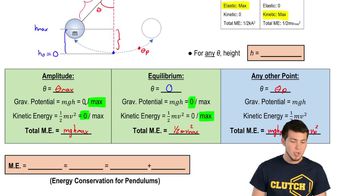
Energy in Pendulums

Nonlinear Pendulum Motion

For larger angles, the simple pendulum does not follow simple harmonic motion exactly, and corrections are needed. The period can be calculated using a series expansion, such as Eq. (14.35), which includes higher-order terms to account for the nonlinearity. This provides a more accurate period by considering deviations from the small-angle approximation.
Recommended video:
Guided course
07:52
Simple Harmonic Motion of Pendulums