
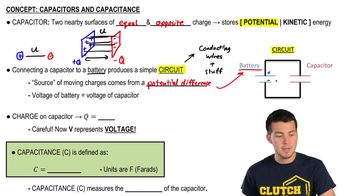
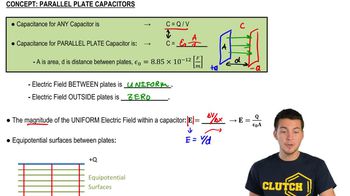
The plates of a parallel-plate capacitor are mm apart, and each carries a charge of magnitude nC. The plates are in vacuum. The electric field between the plates has a magnitude of V/m. What is (a) the potential difference between the plates; (b) the area of each plate; (c) the capacitance?
A parallel-plate air capacitor is to store charge of magnitude pC on each plate when the potential difference between the plates is V.
(a) If the area of each plate is cm2, what is the separation between the plates?
(b) If the separation between the two plates is double the value calculated in part (a), what potential difference is required for the capacitor to store charge of magnitude pC on each plate?
Verified step by step guidance
Verified video answer for a similar problem:
Key Concepts
Capacitance
Parallel-Plate Capacitor
Permittivity of Free Space
A parallel-plate air capacitor of capacitance pF has a charge of magnitude C on each plate. The plates are mm apart.
(a) What is the potential difference between the plates?
(b) What is the area of each plate?
(c) What is the electric field magnitude between the plates?
(d) What is the surface charge density on each plate?
A -F parallel-plate capacitor is connected to a V battery. After the capacitor is fully charged, the battery is disconnected without loss of any of the charge on the plates.
(a) A voltmeter is connected across the two plates without discharging them. What does it read?
(b) What would the voltmeter read if (i) the plate separation were doubled; (ii) the radius of each plate were doubled but their separation was unchanged?
A capacitor is made from two hollow, coaxial, iron cylinders, one inside the other. The inner cylinder is negatively charged and the outer is positively charged; the magnitude of the charge on each is pC. The inner cylinder has radius mm, the outer one has radius mm, and the length of each cylinder is cm.
(a) What is the capacitance?
(b) What applied potential difference is necessary to produce these charges on the cylinders?
A spherical capacitor contains a charge of nC when connected to a potential difference of V. If its plates are separated by vacuum and the inner radius of the outer shell is cm, calculate: (a) the capacitance; (b) the radius of the inner sphere; (c) the electric field just outside the surface of the inner sphere.
Figure E shows a system of four capacitors, where the potential difference across ab is V. How much charge is stored by this combination of capacitors?
