Pearson+ LogoPearson+ Logo
Ch 26: Direct-Current Circuits
Young & Freedman Calc - University Physics 14th Edition
Young & Freedman Calc14th EditionUniversity PhysicsISBN: 9780321973610Not the one you use?Change textbook
Chapter 26, Problem 5a

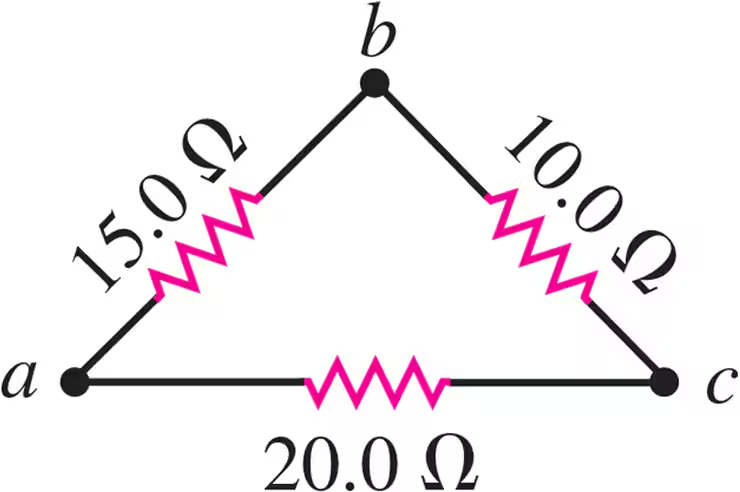
A triangular array of resistors is shown in Fig. E26.5. What current will this array draw from a 35.0 V battery having negligible internal resistance if we connect it across ab?

Verified step by step guidance
1
Identify the resistors in the circuit and their configuration. The resistors are 6.50 Ω, 13.0 Ω, and 9.00 Ω. The resistors are arranged in a triangular configuration.
Determine the equivalent resistance between points a and b. To do this, first recognize that the 13.0 Ω and 9.00 Ω resistors are in series, and their combined resistance is the sum of their individual resistances: R_series = 13.0 Ω + 9.00 Ω.
Calculate the equivalent resistance of the series combination: R_series = 22.0 Ω.
Now, consider the 6.50 Ω resistor, which is in parallel with the series combination of 22.0 Ω. Use the formula for parallel resistors: 1/R_parallel = 1/R_series + 1/R_6.50Ω.
Solve for the equivalent resistance R_parallel using the formula: R_parallel = 1 / (1/22.0 Ω + 1/6.50 Ω). This will give you the total resistance across points a and b. Finally, use Ohm's Law (I = V/R) to find the current drawn from the battery, where V = 35.0 V and R = R_parallel.

Verified video answer for a similar problem:

This video solution was recommended by our tutors as helpful for the problem above.
Video duration:
5m
Was this helpful?

Key Concepts

Here are the essential concepts you must grasp in order to answer the question correctly.

Ohm's Law

Ohm's Law is a fundamental principle in electronics that states the current through a conductor between two points is directly proportional to the voltage across the two points, and inversely proportional to the resistance. It is expressed as I = V/R, where I is the current, V is the voltage, and R is the resistance. This law is essential for calculating the current drawn by the resistor array from the battery.
Recommended video:
Guided course
03:07
Resistance and Ohm's Law

Series and Parallel Circuits

Understanding series and parallel circuits is crucial for analyzing the resistor network. In a series circuit, resistors are connected end-to-end, and the total resistance is the sum of individual resistances. In a parallel circuit, resistors are connected across the same two points, and the total resistance is found using the reciprocal formula: 1/R_total = 1/R1 + 1/R2 + ... . This concept helps determine the equivalent resistance of the triangular array.
Recommended video:
Guided course
09:51
Combining Capacitors in Series & Parallel

Kirchhoff's Circuit Laws

Kirchhoff's Circuit Laws include the Current Law (KCL) and the Voltage Law (KVL), which are essential for analyzing complex circuits. KCL states that the total current entering a junction equals the total current leaving, while KVL states that the sum of the electrical potential differences around any closed network is zero. These laws are useful for solving circuits with multiple loops and branches, like the triangular resistor array.
Recommended video:
Guided course
04:08
Kirchhoff's Junction Rule