
Textbook Question
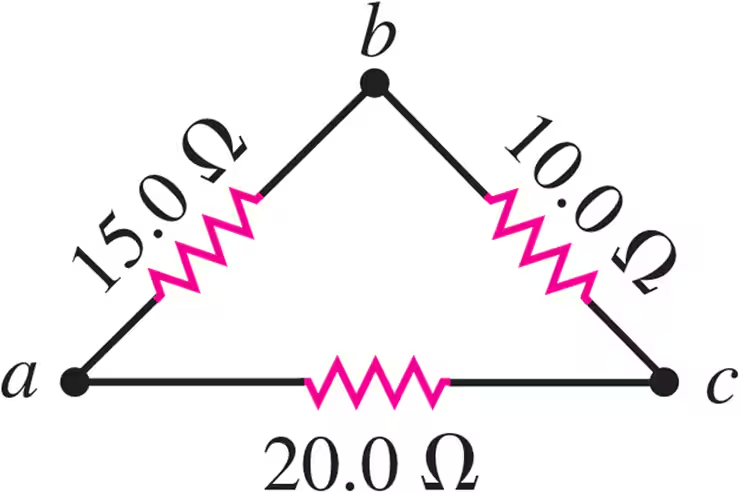
A triangular array of resistors is shown in Fig. E26.5. What current will this array draw from a 35.0 V battery having negligible internal resistance if we connect it across ac?
1468
views

 Verified step by step guidance
 03:07
03:07
 09:51
09:51 04:08
04:08A triangular array of resistors is shown in Fig. E26.5. What current will this array draw from a 35.0 V battery having negligible internal resistance if we connect it across ac?
A uniform wire of resistance R is cut into three equal lengths. One of these is formed into a circle and connected between the other two (Fig. E26.1). What is the resistance between the opposite ends a and b?
A triangular array of resistors is shown in Fig. E26.5. If the battery has an internal resistance of 3.00Ω, what current will the array draw if the battery is connected across bc?
A machine part has a resistor X protruding from an opening in the side. This resistor is connected to three other resistors, as shown in Fig. E26.2. An ohmmeter connected across a and b reads 2.00 Ω. What is the resistance of X?
Power Rating of a Resistor. The power rating of a resistor is the maximum power the resistor can safely dissipate without too great a rise in temperature and hence damage to the resistor. If the power rating of a 15 kΩ resistor is 5.0 W, what is the maximum allowable potential difference across the terminals of the resistor?
A triangular array of resistors is shown in Fig. E26.5. What current will this array draw from a 35.0 V battery having negligible internal resistance if we connect it across ab?