
Ch 26: Direct-Current Circuits
Chapter 26, Problem 21b

Light Bulbs in Series and in Parallel. Two light bulbs have constant resistances of 400Ω and 800Ω. If the two light bulbs are connected in series across a 120 V line, find the power dissipated in each bulb.

Verified step by step guidance
1
First, understand that when resistors (or light bulbs in this case) are connected in series, the total resistance is the sum of the individual resistances. Use the formula: Rtotal=R1+R2.
Calculate the total resistance in the series circuit using the given resistances: Rtotal=400Ω+800Ω.
Next, use Ohm's Law to find the current flowing through the circuit. Ohm's Law states: I=VRtotal, where V is the voltage across the circuit.
Once you have the current, calculate the power dissipated in each bulb using the formula for power: P=I2R. Apply this formula separately for each bulb using their respective resistances.
Finally, substitute the values of current and resistance for each bulb into the power formula to find the power dissipated in the 400Ω bulb and the 800Ω bulb.

Verified video answer for a similar problem:

This video solution was recommended by our tutors as helpful for the problem above.
Video duration:
5m
Was this helpful?

Key Concepts

Here are the essential concepts you must grasp in order to answer the question correctly.

Ohm's Law

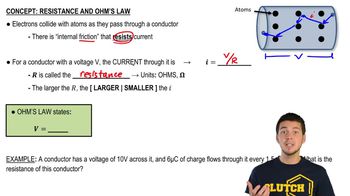
Ohm's Law states that the current through a conductor between two points is directly proportional to the voltage across the two points, given by the formula I = V/R, where I is the current, V is the voltage, and R is the resistance. This principle is essential for calculating the current flowing through the bulbs when connected in series.
Recommended video:
Guided course
03:07
Resistance and Ohm's Law

Series Circuit

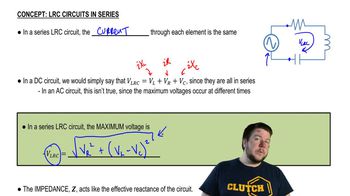
In a series circuit, components are connected end-to-end, so the same current flows through each component. The total resistance is the sum of individual resistances, R_total = R1 + R2. Understanding series circuits is crucial for determining the total resistance and current in the circuit with the two light bulbs.
Recommended video:
Guided course
05:55
LRC Circuits in Series

Power Dissipation

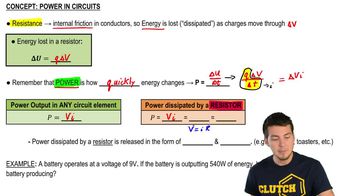
Power dissipation in an electrical component is the rate at which it converts electrical energy into heat and light, calculated using P = I^2R or P = VI. For each bulb, knowing the current and resistance allows us to find the power dissipated, which is essential for understanding how much energy each bulb uses.
Recommended video:
Guided course
06:18
Power in Circuits
Related Practice
Textbook Question

Power Rating of a Resistor. The power rating of a resistor is the maximum power the resistor can safely dissipate without too great a rise in temperature and hence damage to the resistor. A 9.0 kΩ resistor is to be connected across a 120 V potential difference. What power rating is required?

802
views
Textbook Question

Power Rating of a Resistor. The power rating of a resistor is the maximum power the resistor can safely dissipate without too great a rise in temperature and hence damage to the resistor. A 100.0 Ω and a 150.0 Ω resistor, both rated at 2.00 W, are connected in series across a variable potential difference. What is the greatest this potential difference can be without overheating either resistor, and what is the rate of heat generated in each resistor under these conditions?

2187
views
Textbook Question

Light Bulbs in Series and in Parallel. Two light bulbs have constant resistances of 400Ω and 800Ω. If the two light bulbs are connected in series across a 120-V line, find the current through each bulb.

1071
views
1
rank
Textbook Question

Light Bulbs in Series and in Parallel. Two light bulbs have constant resistances of 400Ω and 800Ω. If the two light bulbs are connected in series across a 120 V line, find the total power dissipated in both bulbs.

676
views
1
rank
Textbook Question

Light Bulbs in Series and in Parallel. Two light bulbs have constant resistances of 400Ω and 800Ω. The two light bulbs are now connected in parallel across the 120 V line. Find the current through each bulb.

1023
views
2
rank
Textbook Question

Light Bulbs in Series and in Parallel. Two light bulbs have constant resistances of 400Ω and 800Ω. The two light bulbs are now connected in parallel across the 120 V line. Find the power dissipated in each bulb.

555
views
1
rank