
A triangular array of resistors is shown in Fig. E26.5. What current will this array draw from a 35.0 V battery having negligible internal resistance if we connect it across bc?
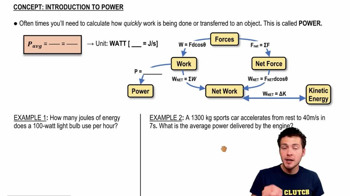
Power Rating of a Resistor. The power rating of a resistor is the maximum power the resistor can safely dissipate without too great a rise in temperature and hence damage to the resistor. If the power rating of a 15 kΩ resistor is 5.0 W, what is the maximum allowable potential difference across the terminals of the resistor?
Verified step by step guidance
Verified video answer for a similar problem:
Key Concepts
Power Rating
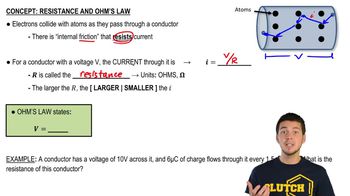
Ohm's Law
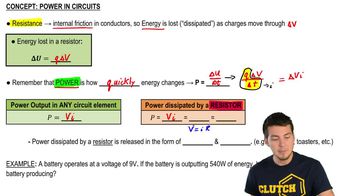
Power Dissipation in Resistors
A triangular array of resistors is shown in Fig. E26.5. What current will this array draw from a 35.0 V battery having negligible internal resistance if we connect it across ac?
A triangular array of resistors is shown in Fig. E26.5. If the battery has an internal resistance of 3.00Ω, what current will the array draw if the battery is connected across bc?
Power Rating of a Resistor. The power rating of a resistor is the maximum power the resistor can safely dissipate without too great a rise in temperature and hence damage to the resistor. A 9.0 kΩ resistor is to be connected across a 120 V potential difference. What power rating is required?
Power Rating of a Resistor. The power rating of a resistor is the maximum power the resistor can safely dissipate without too great a rise in temperature and hence damage to the resistor. A 100.0 Ω and a 150.0 Ω resistor, both rated at 2.00 W, are connected in series across a variable potential difference. What is the greatest this potential difference can be without overheating either resistor, and what is the rate of heat generated in each resistor under these conditions?
Light Bulbs in Series and in Parallel. Two light bulbs have constant resistances of 400Ω and 800Ω. If the two light bulbs are connected in series across a 120-V line, find the current through each bulb.
