
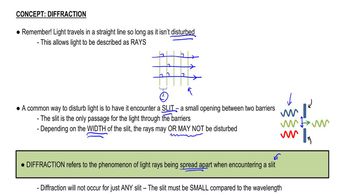
Ch 36: Diffraction
Young & Freedman Calc - University Physics 14th Edition
Young & Freedman Calc14th EditionUniversity PhysicsISBN: 9780321973610Not the one you use?Change textbook
Chapter 35, Problem 13

Monochromatic light of wavelength 580 nm passes through a single slit and the diffraction pattern is observed on a screen. Both the source and screen are far enough from the slit for Fraunhofer diffraction to apply. (a) If the first diffraction minima are at ±90.0°, so the central maximum completely fills the screen, what is the width of the slit? (b) For the width of the slit as calculated in part (a), what is the ratio of the intensity at θ = 45.0° to the intensity at θ = 0?

Verified step by step guidance
1
Step 1: Understand the problem and identify the key concepts. This problem involves Fraunhofer diffraction through a single slit. The first part (a) requires finding the slit width using the condition for the first diffraction minima, and the second part (b) involves calculating the intensity ratio at specific angles using the single-slit diffraction intensity formula.
Step 2: For part (a), use the condition for the first diffraction minima in single-slit diffraction: \( a \sin \theta = m \lambda \), where \( a \) is the slit width, \( \theta \) is the angle of the minima, \( m \) is the order of the minima (\( m = \pm 1 \) for the first minima), and \( \lambda \) is the wavelength of the light. Rearrange the formula to solve for \( a \): \( a = \frac{m \lambda}{\sin \theta} \). Substitute \( m = 1 \), \( \lambda = 580 \; \text{nm} = 580 \times 10^{-9} \; \text{m} \), and \( \theta = 90.0^\circ \).
Step 3: For part (b), use the single-slit diffraction intensity formula: \( I(u) = I_0 \left( \frac{\sin u}{u} \right)^2 \), where \( u = \frac{\pi a \sin \theta}{\lambda} \), \( I_0 \) is the maximum intensity at \( \theta = 0 \), and \( \theta \) is the angle of observation. First, calculate \( u \) for \( \theta = 45.0^\circ \) and \( \theta = 0 \). For \( \theta = 0 \), \( u = 0 \), and for \( \theta = 45.0^\circ \), substitute \( a \) (from part (a)), \( \lambda \), and \( \sin 45.0^\circ \) into the formula for \( u \).
Step 4: Compute the ratio of intensities \( \frac{I(45.0^\circ)}{I(0)} \). Since \( I(0) = I_0 \), the ratio simplifies to \( \left( \frac{\sin u}{u} \right)^2 \) for \( u \) at \( \theta = 45.0^\circ \). Substitute the value of \( u \) calculated in Step 3 into this expression to find the ratio.
Step 5: Summarize the results. The slit width \( a \) is determined from part (a) using the diffraction minima condition, and the intensity ratio is calculated in part (b) using the single-slit diffraction intensity formula. Ensure all units are consistent and verify the calculations for accuracy.

Verified video answer for a similar problem:

This video solution was recommended by our tutors as helpful for the problem above.
Video duration:
9m
Was this helpful?

Key Concepts

Here are the essential concepts you must grasp in order to answer the question correctly.

Fraunhofer Diffraction

Fraunhofer diffraction occurs when light waves pass through a slit and are observed at a distance where the wavefronts can be considered parallel. This type of diffraction is characterized by the formation of a pattern of bright and dark fringes on a screen, which can be analyzed using mathematical equations. The angle of diffraction and the slit width are crucial in determining the positions of these minima and maxima.
Recommended video:

Diffraction Minima

Diffraction minima are points in the diffraction pattern where the intensity of light is zero due to destructive interference. For a single slit, the positions of these minima can be calculated using the formula a sin(θ) = mλ, where 'a' is the slit width, 'θ' is the angle of the minima, 'm' is the order of the minima, and 'λ' is the wavelength of the light. Understanding these minima is essential for determining the slit width and analyzing the intensity distribution.
Recommended video:

Intensity Ratio in Diffraction Patterns

The intensity of light in a diffraction pattern varies with angle and can be described by the intensity function derived from the amplitude of the wave. The ratio of intensities at different angles, such as u = 45.0° and u = 0°, can be calculated using the intensity formula I(θ) = I0 (sin(β)/β)², where β is related to the angle and slit width. This ratio provides insight into how the diffraction pattern changes with angle and is important for understanding light behavior in diffraction.
Recommended video:
Related Practice
Textbook Question

Diffraction occurs for all types of waves, including sound waves. High-frequency sound from a distant source with wavelength 9.00 cm passes through a slit 12.0 cm wide. A microphone is placed 8.00 m directly in front of the center of the slit, corresponding to point O in Fig. 36.5a . The microphone is then moved in a direction perpendicular to the line from the center of the slit to point O. At what distances from O will the intensity detected by the microphone be zero?

964
views
Textbook Question

A series of parallel linear water wave fronts are traveling directly toward the shore at 15.0 cm/s on an otherwise placid lake. A long concrete barrier that runs parallel to the shore at a distance of 3.20 m away has a hole in it. You count the wave crests and observe that 75.0 of them pass by each minute, and you also observe that no waves reach the shore at ±61.3 cm from the point directly opposite the hole, but waves do reach the shore everywhere within this distance. How wide is the hole in the barrier?

672
views
Textbook Question

A series of parallel linear water wave fronts are traveling directly toward the shore at 15.0 cm/s on an otherwise placid lake. A long concrete barrier that runs parallel to the shore at a distance of 3.20 m away has a hole in it. You count the wave crests and observe that 75.0 of them pass by each minute, and you also observe that no waves reach the shore at ±61.3 cm from the point directly opposite the hole, but waves do reach the shore everywhere within this distance. At what other angles do you find no waves hitting the shore?

699
views
Textbook Question

A slit 0.240 mm wide is illuminated by parallel light rays of wavelength 540 nm. The diffraction pattern is observed on a screen that is 3.00 m from the slit. The intensity at the center of the central maximum (θ = 0°) is 6.00 x 10⁻⁶ W/m2. What is the distance on the screen from the center of the central maximum to the first minimum?

671
views
Textbook Question

A slit 0.240 mm wide is illuminated by parallel light rays of wavelength 540 nm. The diffraction pattern is observed on a screen that is 3.00 m from the slit. The intensity at the center of the central maximum (θ = 0°) is 6.00 x 10⁻⁶ W/m2. What is the intensity at a point on the screen midway between the center of the central maximum and the first minimum?

756
views
Textbook Question

Monochromatic light of wavelength 592 nm from a distant source passes through a slit that is 0.0290 mm wide. In the resulting diffraction pattern, the intensity at the center of the central maximum (θ = 0°) is 4.00x10⁻⁵ W/m2. What is the intensity at a point on the screen that corresponds to θ = 1.20°?

1149
views