Ch 37: Special Relativity
Chapter 36, Problem 14

A rocket ship flies past the earth at 91.0% of the speed of light. Inside, an astronaut who is undergoing a physical examination is having his height measured while he is lying down parallel to the direction in which the ship is moving. (a) If his height is measured to be 2.00 m by his doctor inside the ship, what height would a person watching this from the earth measure? (b) If the earth-based person had measured 2.00 m, what would the doctor in the spaceship have measured for the astronaut’s height? Is this a reasonable height?

Verified step by step guidance
1
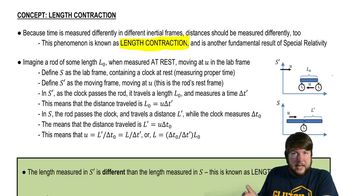
Step 1: Understand the concept of length contraction. Length contraction is a phenomenon predicted by Einstein's theory of special relativity, where the length of an object moving relative to an observer is measured to be shorter than its proper length (the length measured in the object's rest frame). The formula for length contraction is: L=L01-v2c2, where L is the contracted length, L0 is the proper length, v is the relative velocity, and c is the speed of light.
Step 2: Solve part (a). The astronaut's height is measured as 2.00 m inside the ship, which is the proper length L0. To find the height as measured by a person on Earth, use the length contraction formula. Substitute L0 = 2.00 m, v = 0.91c, and calculate 1-v2c2 to find the contracted length L.
Step 3: Solve part (b). If the Earth-based person measures the astronaut's height to be 2.00 m, this is the contracted length L. To find the proper length L0 as measured by the doctor inside the ship, rearrange the length contraction formula to solve for L0: L0=L1-v2c2. Substitute L = 2.00 m and v = 0.91c to calculate L0.
Step 4: Interpret the results. Compare the values obtained in parts (a) and (b). Discuss how the measurements differ depending on the observer's frame of reference and why this is consistent with the principles of special relativity.
Step 5: Reflect on the reasonableness of the height. Consider whether the calculated proper length in part (b) is realistic for a human astronaut. If the proper length is significantly larger than typical human heights, discuss how relativistic effects can lead to such results and why this is a theoretical outcome rather than a practical concern.

Verified video answer for a similar problem:

This video solution was recommended by our tutors as helpful for the problem above.
Video duration:
7m
Was this helpful?

Key Concepts

Here are the essential concepts you must grasp in order to answer the question correctly.

Relativity of Length Contraction

Length contraction is a phenomenon predicted by Einstein's theory of special relativity, which states that an object in motion will appear shorter in the direction of its motion to an observer at rest. This effect becomes significant as the object's speed approaches the speed of light. For example, if an astronaut measures his height as 2.00 m while traveling at 91.0% of the speed of light, an observer on Earth would measure a shorter height due to this contraction.
Recommended video:
Guided course
07:02
Length Contraction

Reference Frames

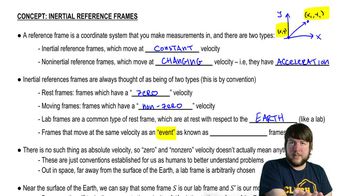
A reference frame is a perspective from which measurements are made, and it plays a crucial role in understanding motion and relativistic effects. In this scenario, the astronaut's measurements are taken in the rocket's reference frame, while the Earth observer's measurements are taken in a stationary reference frame. The differences in measurements arise because the two observers are in different states of motion, highlighting the relativity of simultaneity and measurement.
Recommended video:
Guided course
14:10
Inertial Reference Frames

Lorentz Factor

The Lorentz factor is a mathematical factor that quantifies the effects of time dilation and length contraction in special relativity. It is defined as γ = 1 / √(1 - v²/c²), where v is the object's velocity and c is the speed of light. At 91.0% of the speed of light, the Lorentz factor becomes significant, allowing us to calculate how much the astronaut's height appears contracted to an Earth observer, and vice versa, providing a basis for understanding the measurements in the problem.
Recommended video:
Guided course
14:16
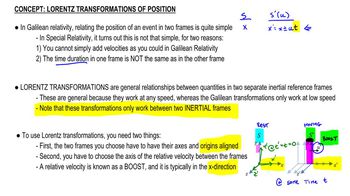
Lorentz Transformations of Position
Related Practice
Textbook Question

An alien spacecraft is flying overhead at a great distance as you stand in your backyard. You see its searchlight blink on for 0.1500.150 s. The first officer on the spacecraft measures that the searchlight is on for 12.012.0 ms.

(a) Which of these two measured times is the proper time?

(b) What is the speed of the spacecraft relative to the earth, expressed as a fraction of the speed of light cc?

833
views
Textbook Question

Why Are We Bombarded by Muons? Muons are unstable subatomic particles that decay to electrons with a mean lifetime of 2.2 μs. They are produced when cosmic rays bombard the upper atmosphere about 10 km above the earth's surface, and they travel very close to the speed of light. The problem we want to address is why we see any of them at the earth's surface. (a) What is the greatest distance a muon could travel during its 2.2 μs lifetime? (b) According to your answer in part (a), it would seem that muons could never make it to the ground. But the 2.2 μs lifetime is measured in the frame of the muon, and muons are moving very fast. At a speed of 0.999c, what is the mean lifetime of a muon as measured by an observer at rest on the earth? How far would the muon travel in this time? Does this result explain why we find muons in cosmic rays? (c) From the point of view of the muon, it still lives for only 2.2 μs, so how does it make it to the ground? What is the thickness of the 10 km of atmosphere through which the muon must travel, as measured by the muon? Is it now clear how the muon is able to reach the ground?

1281
views
Textbook Question

An unstable particle is created in the upper atmosphere from a cosmic ray and travels straight down toward the surface of the earth with a speed of 0.99540c relative to the earth. A scientist at rest on the earth’s surface measures that the particle is created at an altitude of 45.0 km. (a) As measured by the scientist, how much time does it take the particle to travel the 45.0 km to the surface of the earth? (b) Use the length-contraction formula to calculate the distance from where the particle is created to the surface of the earth as measured in the particle’s frame. (c) In the particle’s frame, how much time does it take the particle to travel from where it is created to the surface of the earth? Calculate this time both by the time dilation formula and from the distance calculated in part (b). Do the two results agree?

389
views
Textbook Question

A pursuit spacecraft from the planet Tatooine is attempting to catch up with a Trade Federation cruiser. As measured by an observer on Tatooine, the cruiser is traveling away from the planet with a speed of 0.600c. The pursuit ship is traveling at a speed of 0.800c relative to Tatooine, in the same direction as the cruiser. (a) For the pursuit ship to catch the cruiser, should the velocity of the cruiser relative to the pursuit ship be directed toward or away from the pursuit ship? (b) What is the speed of the cruiser relative to the pursuit ship?

501
views
Textbook Question

Two particles are created in a high-energy accelerator and move off in opposite directions. The speed of one particle, as measured in the laboratory, is 0.650c, and the speed of each particle relative to the other is 0.950c. What is the speed of the second particle, as measured in the laboratory?

881
views
Textbook Question

Tell It to the Judge. (a) How fast must you be approaching a red traffic light (λ = 675 nm) for it to appear yellow (λ = 575 nm)? Express your answer in terms of the speed of light. (b) If you used this as a reason not to get a ticket for running a red light, how much of a fine would you get for speeding? Assume that the fine is \$1.00 for each kilometer per hour that your speed exceeds the posted limit of 90 km/h.

317
views