Plurality With Elimination Method: Videos & Practice Problems
The Plurality With Elimination Method is an election method that uses voters’ ranked ballots to find a winner. The process begins by counting each candidate’s first ranked votes. If one candidate has a majority, meaning more than 50% of the first ranked votes, that candidate wins immediately.
If no candidate has a majority, the candidate with the fewest first ranked votes is eliminated. The election is then checked again using the updated first-choice totals, and this continues until one candidate has a majority. A key idea is that only first-place rankings are counted at each step, and the winner must have more than half of the total active first ranked votes, written as \(>50\\%\) . This method combines a plurality count with repeated elimination to produce a majority winner.
Plurality With Elimination Method


An election with three candidates (Camille, Eliza, & Teddy) will be determined by the plurality with elimination method. Who wins the election?
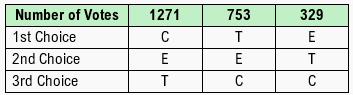
Camille
Eliza
Teddy
Plurality With Elimination Method Example 1
Here's what students ask on this topic:
The Plurality With Elimination Method is an election system that uses voters' ranked ballots to determine a winner. Initially, only the first-choice votes for each candidate are counted. If a candidate receives more than 50% of these first-choice votes, they win immediately. However, if no candidate achieves this majority, the candidate with the fewest first-choice votes is eliminated. The ballots that ranked the eliminated candidate first are then re-examined, and their votes are transferred to the next preferred candidate on those ballots. This process of elimination and vote redistribution continues until one candidate secures a majority of the active first-choice votes. This method ensures that the winner has broad support, combining a simple plurality count with repeated elimination rounds to find a majority winner.
The Plurality With Elimination Method ensures a majority winner by repeatedly eliminating the candidate with the fewest first-choice votes and redistributing those votes according to voters' next preferences. At each stage, only the first-choice votes of the remaining candidates are counted. This process continues until a candidate obtains more than 50% of the active first-choice votes, mathematically expressed as . By eliminating the least popular candidates and reallocating their votes, the method prevents a candidate from winning solely by having a simple plurality without majority support. Instead, it guarantees that the final winner has majority backing from the voters who remain in the race, reflecting a broader consensus.
In the Plurality With Elimination Method, when a candidate is eliminated for having the fewest first-choice votes, the ballots that ranked that candidate first are not discarded. Instead, these ballots are re-examined to identify the next preferred candidate who is still in the race. The votes are then transferred to that candidate as their new first-choice votes. This redistribution continues with each elimination round, ensuring that voters' preferences beyond their first choice are considered. This process helps maintain the influence of voters whose top choice is no longer viable, allowing their subsequent preferences to impact the election outcome until a candidate achieves a majority.
Only the first-place rankings are counted at each step in the Plurality With Elimination Method because the method focuses on identifying the candidate with the majority of active first-choice votes. At the start, all first-choice votes are counted. If no candidate has a majority, the candidate with the fewest first-choice votes is eliminated. Then, the ballots of the eliminated candidate are reallocated to the next preferred candidate, effectively updating the first-choice votes for the remaining candidates. This stepwise counting of first-place votes simplifies the process and ensures that the winner has majority support among the active candidates. It also reflects voters' highest preferences among the remaining options at each stage.
The Plurality With Elimination Method differs from simple plurality voting by requiring a candidate to have a majority () of first-choice votes to win, rather than just the most votes. In simple plurality voting, the candidate with the highest number of votes wins, even if they do not have majority support. In contrast, the Plurality With Elimination Method eliminates the candidate with the fewest votes in successive rounds and redistributes their votes based on voters' next preferences. This process continues until a candidate achieves a majority, ensuring broader support and reducing the chance of a winner who is opposed by most voters. It combines the simplicity of plurality with a mechanism to find a majority winner.